Takealot Competitor Research Guide: Find Better Product Opportunities
Takealot competitor research matters when you need to validate demand, pricing pressure, and review barriers before you commit stock.
A product can look attractive on the surface and still be a poor choice if:
- the category is already crowded with entrenched sellers
- pricing is unstable enough to squeeze margin
- review depth creates a credibility gap you cannot close quickly
- recent momentum is weaker than the headline numbers suggest
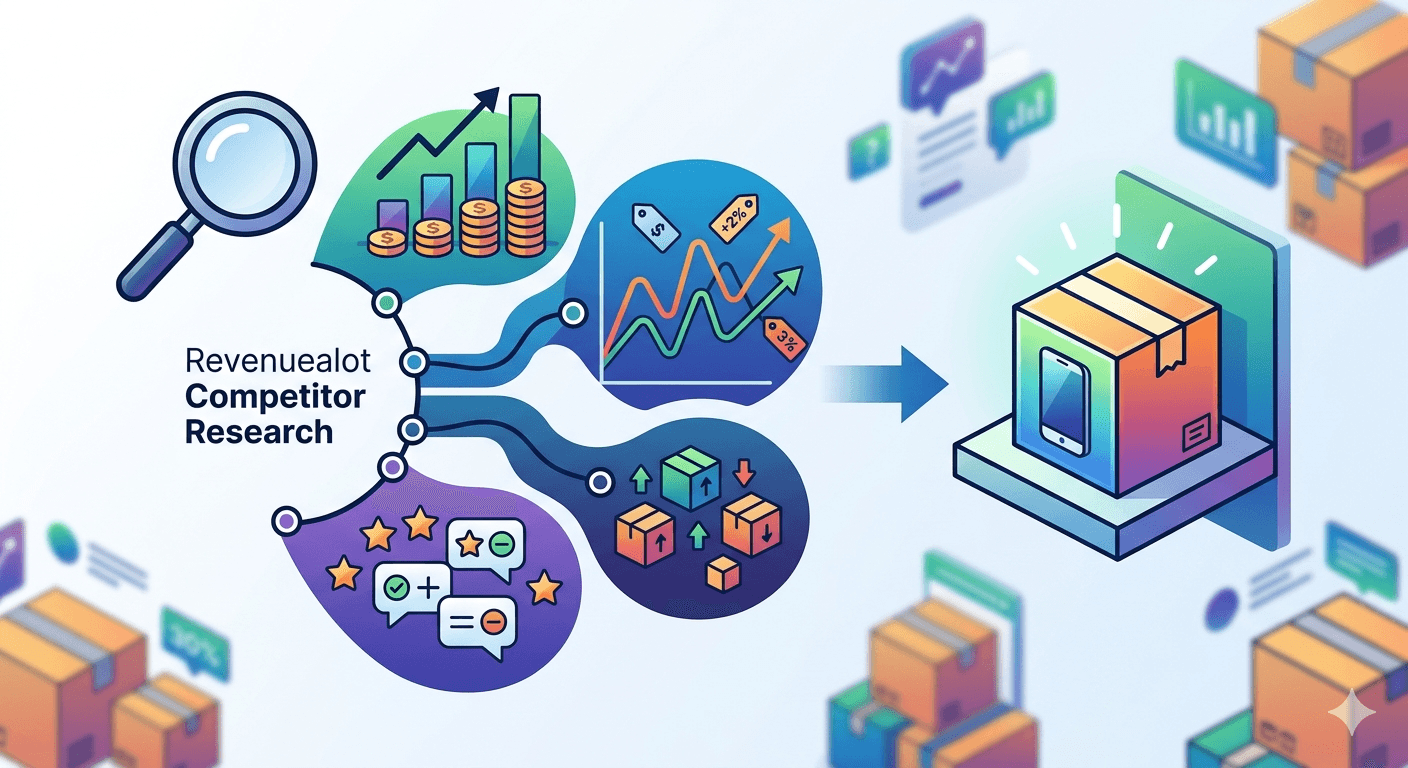
That is where Revenuealot Competitor Research becomes useful. Instead of judging a product from one listing or one revenue estimate, you can compare a group of competing products and read the market in context.
If you want the feature walkthrough beside this article, start with the Competitor Research docs. If you already know what you want to analyze, go straight to Competitor Research.
Quick answer: what makes a Takealot product opportunity worth pursuing?
The best opportunities on Takealot are usually not the products with the biggest headline sales. They are the products where four things line up at the same time:
- demand is real enough to justify entering
- prices are not collapsing every time the market gets competitive
- review quality leaves room for a better offer
- the category still has space for another seller with a clear angle
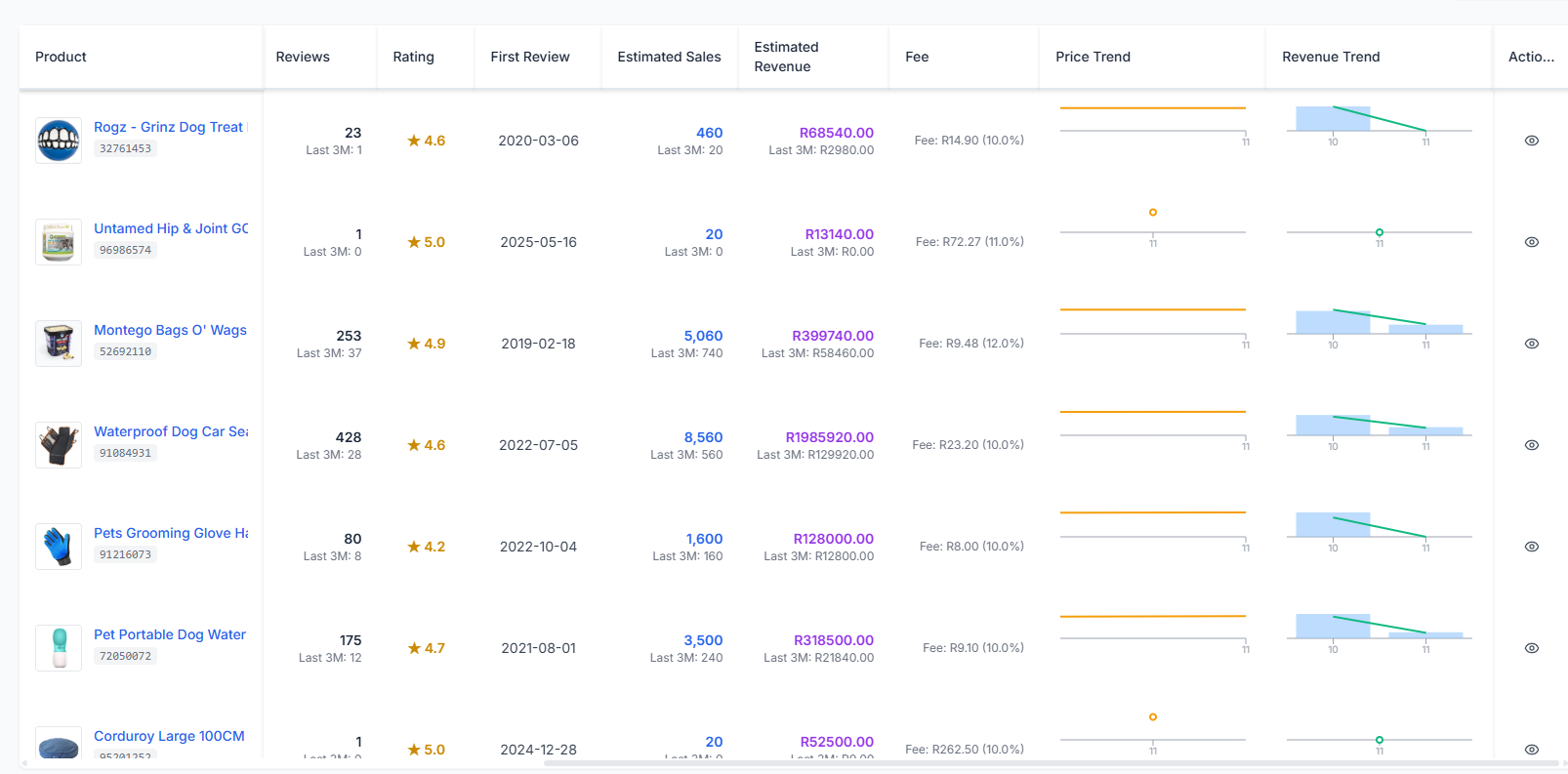
That is why Competitor Research is useful for product selection. It lets you compare estimated revenue, sales, review depth, price history, and recent changes together instead of guessing from one number.
Why sales volume alone is a weak way to choose a product
Many sellers begin with a simple question: which products seem to sell the most?
That is understandable, but it creates a common mistake. High volume tells you that buyers exist. It does not tell you whether entering that market will still be commercially sensible for you.
You still need answers to questions like:
- Is the revenue level stable or seasonal?
- Are sellers defending the category through price cuts?
- Do buyers already trust a small group of established listings?
- Is there a visible product gap you can actually improve on?
Without that context, a high-demand product can still become a slow-margin, high-friction launch.
Compare a group of competitor products, not one impressive listing
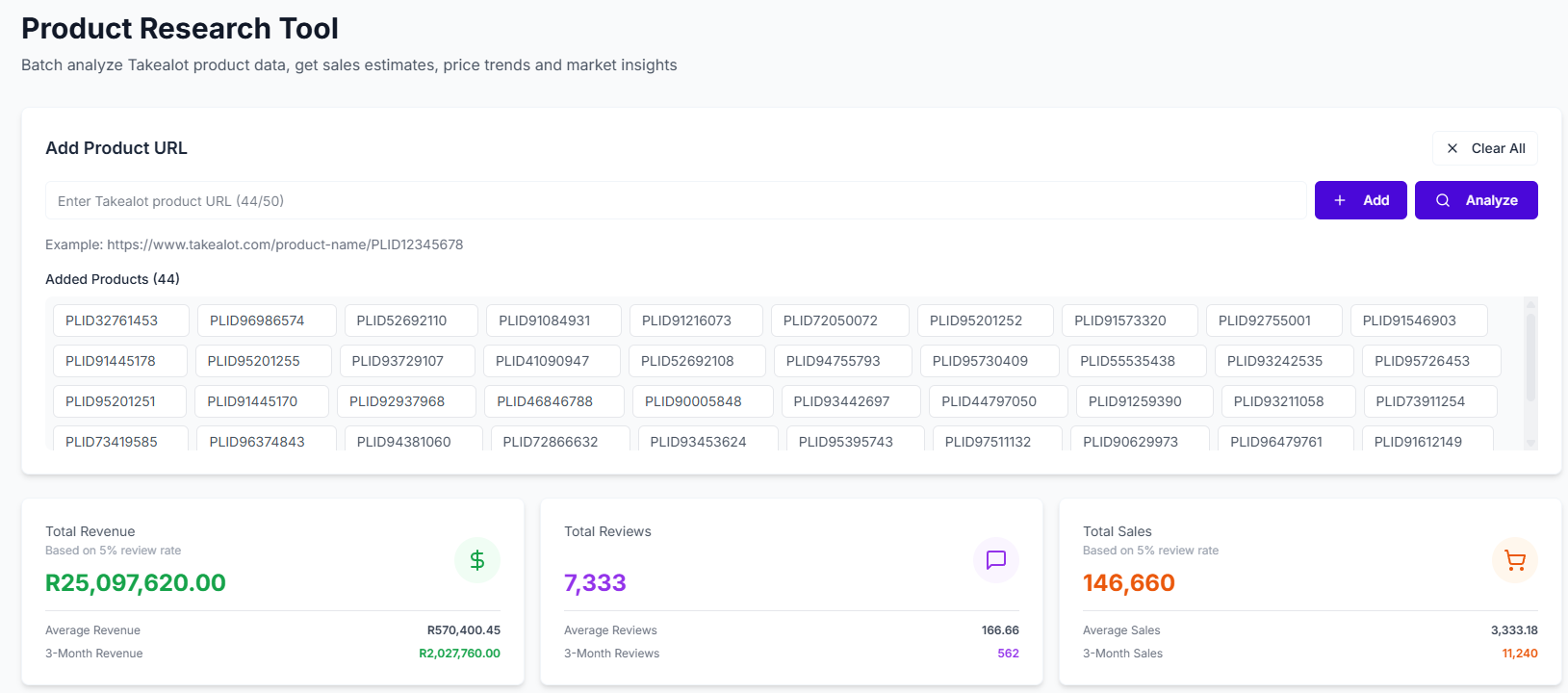
One of the most useful parts of Competitor Research is that you can batch analyze up to 50 competitor products. That matters because real opportunity is usually hidden in category patterns, not in a single hero SKU.
Once you compare a cluster of direct competitors, you can start reading the market more realistically:
- estimated revenue and sales show whether the category is meaningfully active
- current price and historical price movement show how hard sellers are fighting
- review count and rating show how strong the trust barrier already is
- three-month movement helps you see whether the category is steady, rising, or fading
Signal in Competitor Research | What it tells you | Why it matters before launch |
|---|---|---|
Estimated revenue and sales | Whether buyers are active in the category | Confirms that demand is real, not assumed |
Current price plus highest and lowest price | How wide the pricing band is | Helps you judge margin pressure |
Historical price trend | Whether the category stays stable or gets dragged into repeated price drops | Reveals how difficult it may be to defend price |
Review count and rating | How much buyer trust incumbents have built | Shows whether you are entering an easy or defended market |
Three-month comparison | Whether the category is growing, flattening, or cooling off | Prevents decisions based on outdated momentum |
Price trends usually matter more than today's visible price
Many sellers stop at the current selling price. That is not enough.
For product research, the more useful question is: how has pricing behaved over time?
That is why the historical price chart matters. It helps you tell the difference between:
- a category with relatively stable pricing
- a category that spikes during promotions and then recovers
- a category that keeps slipping because competitors are constantly undercutting each other
If you see healthy revenue paired with repeated sharp price drops, that is often a warning sign. The category may look exciting, but the commercial pressure could already be high.
If the pricing range stays more stable, you are usually looking at a healthier market structure.
Reviews often reveal the real gap faster than revenue does
Revenue tells you what is selling. Reviews often tell you why buyers are still not fully satisfied.
That is where Competitor Research becomes more than a market sizing tool. When you open detail analysis, the review statistics, variant comparison, and review keyword analysis can help you spot where the market is under-serving buyers.
Look for repeated complaints such as:
- packaging arrives damaged
- sizing or fit is inconsistent
- product photos overpromise
- parts or accessories are missing
- quality drops across certain variants
Those patterns matter because they show you where a new offer could be clearer, better built, or better positioned.
A simple way to tell the difference between a promising niche and a crowded trap
What you see | Likely reading | Better decision |
|---|---|---|
Decent revenue, moderate review depth, stable pricing | Accessible category with room for a better offer | Keep validating the niche |
High revenue, very high review depth, strong ratings | Mature market with strong incumbents | Enter only if your differentiation is obvious |
Strong sales but repeated sharp price drops | Category is active but margin pressure is likely heavy | Be cautious before committing stock |
Weak three-month movement and low sales across competitors | Demand may be too soft | Move on quickly |
Reviews repeatedly mention the same product gap | Buyers are telling you what is still missing | Explore whether you can solve that gap |
A practical 20-minute workflow for validating a Takealot product opportunity
1. Start with the most direct competitors
Choose products that are genuinely close in category, price position, and buyer intent. Do not start with a huge mixed list.
2. Confirm there is enough demand to matter
Use estimated revenue and sales to answer a basic question first: is this category worth your time at all?
If the numbers are weak across the whole comparison set, there is usually no reason to keep digging.
3. Check whether price competition is manageable
Look at current price together with the historical range. You are trying to tell whether the market rewards solid offers or punishes everyone into constant repricing.
4. Read reviews for gaps, not just credibility
A product with average reviews is not automatically a bad market. It may actually be a better opportunity if the complaints are specific and fixable.
5. Use the last three months as a reality check
Recent movement helps you avoid building a decision around old momentum. If the category has cooled off, the older headline numbers can mislead you.
When you should probably walk away from a product
Sometimes the right product research outcome is not "this looks interesting." It is "skip this one."
That is usually the smarter decision when:
- review depth is overwhelming and incumbents are well defended
- price history shows constant aggressive discounting
- revenue looks attractive but recent movement is clearly weakening
- negative reviews expose issues you cannot realistically solve
- the market has activity, but no clear angle for you to compete on
Walking away early is part of good product research. It protects time, budget, and inventory from getting tied up in the wrong category.
FAQ
How many competitor products should I compare before judging a category?
Start with a focused group of direct competitors rather than a massive list. You usually need enough products to see patterns, not enough to create noise. Competitor Research supports batch analysis, so you can expand once the first comparison reveals where the real pressure sits.
Is high estimated revenue enough to justify entering a market?
No. High revenue can still sit inside a category with heavy price pressure or a very strong review barrier. Revenue becomes more useful when you read it beside price behavior, review depth, and recent movement.
What should I do after I identify a promising product opportunity?
The next step is usually to understand how competitors are winning visibility. That is where Keyword Reverse becomes useful. If you want broader search demand validation, pair that with Keyword Research.
Final takeaway
Good Takealot product research is not about chasing the product that looks hottest today. It is about finding a market where demand, price behavior, review structure, and recent momentum still leave you room to build a credible offer.
Revenuealot Competitor Research helps you make that decision with more discipline. Instead of guessing from surface-level sales numbers, you can judge whether the category is worth entering before you commit to sourcing, listing work, or ad budget.
If you are reviewing a shortlist now, open Competitor Research and compare the products side by side. Then keep the Competitor Research docs open if you want a deeper feature walkthrough while you work.