How Much Does It Cost to Sell on Makro Marketplace? The Fees Behind Your Profit
Selling a product for R500 does not mean I have R500 available to restock or pay myself. Before choosing a selling price, I need to account for marketplace deductions, stock costs, packaging and the monthly platform fee.
So, how much does it cost to sell on Makro Marketplace? The starting point is R230 including VAT per month when you have at least one active listing, plus category-based commission and applicable transport charges. FBM sellers also need to consider first-mile and storage charges when applicable.
In this guide, I’ll show how I would turn those charges into a practical product budget—and check whether a discount still leaves enough margin.
1. How Much Does It Cost to Sell on Makro Marketplace? Monthly Fees and Commission
The R230 Platform Fee: What I Budget Even Without Sales
Makro’s platform fee applies when you have an active listing, even if you make no sales. If sales proceeds cannot cover it, the unpaid amount accumulates rather than disappearing.
For pricing purposes, I divide the monthly fee by expected units sold:
Monthly units sold | Monthly platform fee, including VAT | Allocated cost per unit |
|---|---|---|
10 | R230 | R23.00 |
50 | R230 | R4.60 |
100 | R230 | R2.30 |
This allocation is my budgeting method, rather than an additional Makro charge. I use a realistic sales forecast: allocating the fee across 100 units will overstate profitability if I only sell 10.
Category Commission and VAT: How I Check My Actual Deduction
I check the commission assigned to the product’s specific vertical before setting its price. I do not assume that every product in a broad category attracts the same rate.
VAT status also affects the calculation. Makro’s published formulas for standard-rated products are:
Seller VAT status | Commission calculation, including VAT on the fee |
|---|---|
VAT-registered | (VAT-inclusive selling price ÷ 1.15) × commission rate × 1.15 |
Non-VAT-registered | Selling price × commission rate × 1.15 |
Using a hypothetical 10% commission rate and a R500 selling price, the deduction is R50 for a VAT-registered seller and R57.50 for a non-VAT-registered seller. The 10% rate is an example, not a universal Makro commission.
I also keep payout calculations separate from VAT accounting. A VAT-registered seller’s customer payment includes VAT that must be treated correctly when calculating profit.
2. Makro Marketplace Fulfilment Costs: Delivery, Returns and Storage
FBS vs FBM: Which Transport Charges Apply to My Products?
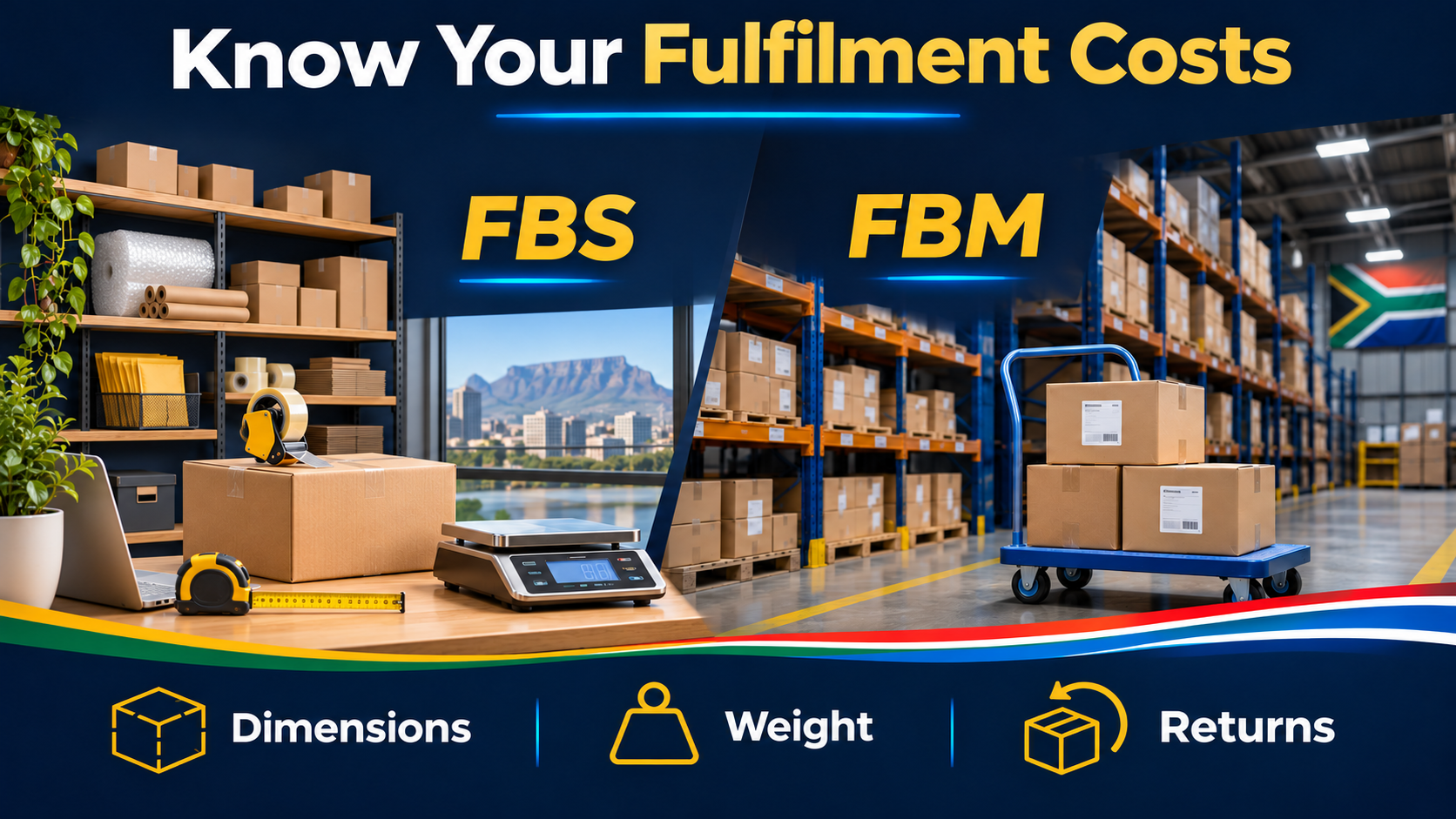
Fulfilled by Seller (FBS) and Fulfilled by Makro (FBM) have different transport rate cards. For example, the published Small/Light final-mile rate is R41 excluding VAT under FBS and R34 excluding VAT under FBM.
Cost to check | FBS | FBM |
|---|---|---|
Final-mile delivery | Charged per successfully delivered unit | Charged per successfully delivered unit |
Return transport | Separate charge following a customer return | Separate charge following a customer return |
First-mile consignment | Not an FBM inbound charge | Relevant when sending stock to Makro |
Makro warehouse storage | Not applicable | Relevant when storage charging applies |
Transport classification depends on the packaged dimensions and weight recorded in the listing. Two separately sold units attract two transport fees, even within one order. A correctly listed multipack counts as one unit, although its larger dimensions may change its fee band.
Before comparing fulfilment models, I would:
- Measure and weigh the fully packaged product.
- Check the correct transport band for each model.
- Add my own FBS handling costs or allocated FBM inbound costs.
A lower delivery rate alone does not establish which model is cheaper overall.
First-Mile Fees and Stock Cover: What I Check Before Sending Inventory
As checked on 4 November 2026, FBM first-mile transport is free until 30 November 2026, with charging scheduled from 1 December 2026. Makro also states that no storage fees will be charged for the remainder of 2026. These are dated benefits, so I would not build permanent pricing around them.
The published storage framework uses a 35-day stock-cover threshold:
Days of stock cover = average stock ÷ average daily sales
For example, average stock of 120 units and average daily sales of three units produce 40 days of cover. That exceeds the stated threshold when storage charges apply.
I would use the detailed storage guide for slow-moving products rather than assume that sending more inventory always improves availability profitably.
3. How I Calculate Makro Selling Costs and Set a Profitable Price
A Worked Rand Example: From Selling Price to Profit
Consider a non-VAT-registered FBS seller selling a Small/Light product for R500. I’ll assume a 10% commission, R250 landed product cost, R10 packaging cost and 50 units sold monthly.
The transport charge is R41 excluding VAT, or R47.15 including VAT.
For this example, all costs represent the amounts the seller actually bears.
Calculation per unit | Amount |
|---|---|
Selling price | R500.00 |
Commission: R500 × 10% × 1.15 | −R57.50 |
Final-mile transport, including VAT | −R47.15 |
Balance after these marketplace deductions | R395.35 |
Landed product cost | −R250.00 |
Packaging | −R10.00 |
Contribution before monthly platform fee | R135.35 |
Platform fee allocation: R230 ÷ 50 | −R4.60 |
Amount remaining after listed costs | R130.75 |
The R395.35 balance is not profit. Stock and packaging still need to be paid for.

Likewise, R130.75 is not final business net profit: advertising, labour, software, returns, other overheads and income tax remain outside this example. I would add the relevant costs before deciding whether the product meets my target.
My Break-Even Check Before Listing or Discounting
At R135.35 contribution per unit, covering only the R230 monthly platform fee requires:
R230 ÷ R135.35 = 1.70, rounded up to two completed, non-returned sales.
If I have other monthly fixed costs, I add them to the numerator.
Now suppose I reduce the price to R450. Commission becomes R51.75, leaving:
R450 − R51.75 − R47.15 − R250 − R10 = R91.10
A 10% price reduction cuts contribution by approximately 32.7%. I would need about 49% more units to generate the same total contribution.
I also test a return. Makro states that an approved return reverses the sale, credits the original commission and adds return transport charges.
For this Small/Light FBS example, delivery plus return transport totals R94.30 including VAT, before packaging loss or product damage.
That is why I check both the normal-sale margin and the cost of an unsuccessful sale before approving a promotion.
Frequently Asked Questions
1. How much does it cost to sell on Makro Marketplace each month?
I budget R230 including VAT for the platform fee when an active listing exists, then add commission, transport and any applicable FBM costs.
2. Do I pay Makro’s platform fee if I make no sales?
Yes, if I have an active listing. Insufficient sales proceeds do not waive the charge; unpaid fees accumulate.
3. What commission percentage does Makro charge?
There is no single rate for every product. I check the current commission for the relevant product vertical before calculating my margin.
4. Are Makro delivery fees charged per order or per unit?
They are charged per successfully delivered unit. I therefore budget two delivery fees when an order contains two separately sold units.
5. How do I calculate profit after Makro seller fees?
I subtract commission, transport, product cost, packaging and allocated fixed costs from sales, then include returns and other operating expenses. For VAT-registered businesses, I use a consistent VAT accounting basis.
Official sources
Makro Marketplace: Understanding all the fees
Makro Marketplace: How commission fees are calculated