Makro Black Friday: A South African Seller’s Guide to More Sales and Better Margins
Makro Black Friday can generate more orders while leaving you with less profit per sale. A discounted appliance may sell quickly, but commission, delivery charges and returns can consume the margin you expected to earn.
For South African marketplace sellers, preparation starts at SKU level: which products deserve a discount, how much stock can you fulfil, and what price still makes commercial sense?
This guide provides practical calculations and operating checks for answering those questions.
Source check: 4 November 2026. Campaign dates, submission requirements and fees can change; confirm the latest information in Makro’s Seller Help Centre before committing stock.
1. Makro Black Friday Planning: Choose Products with Potential
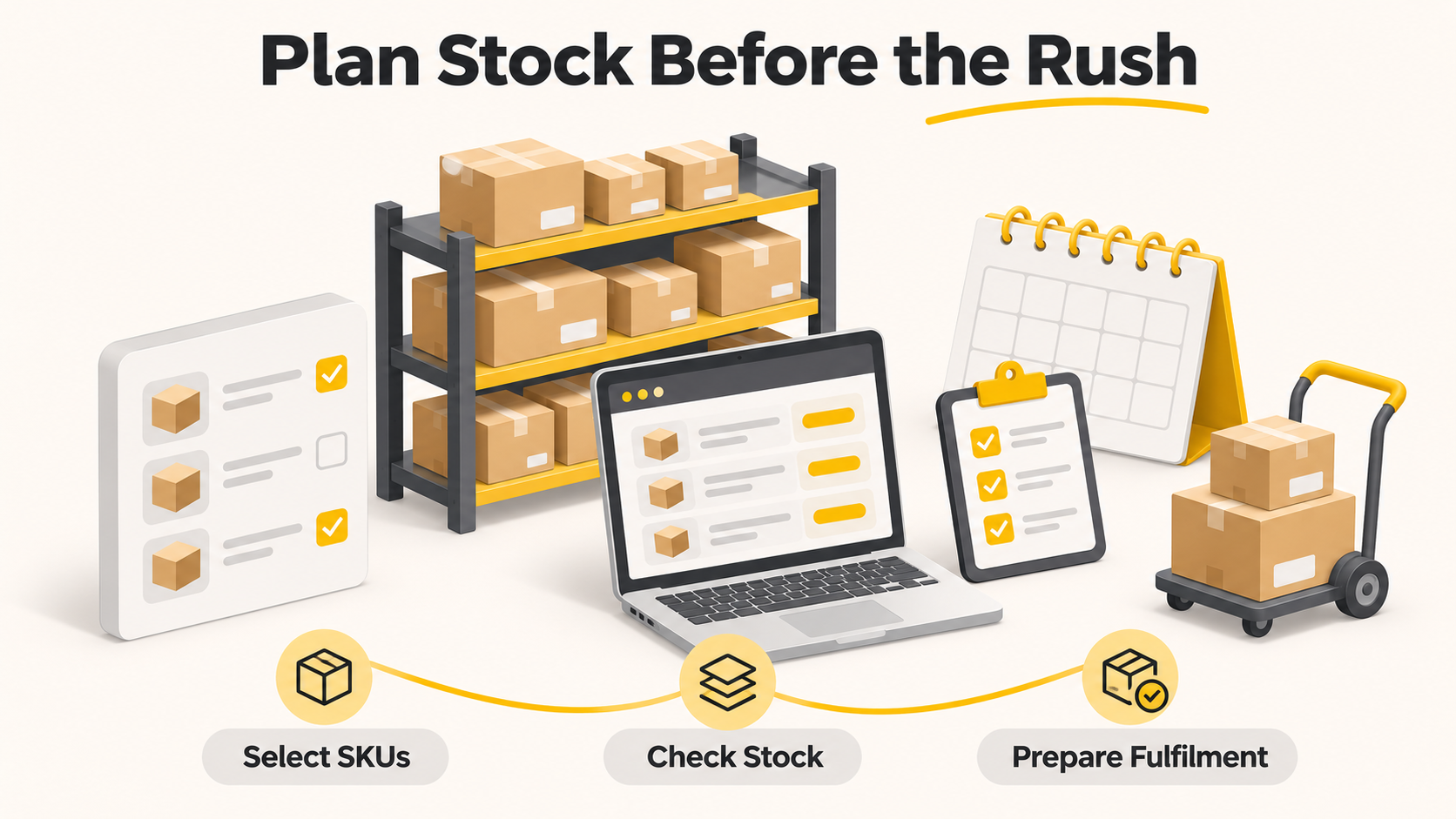
Use sales history and seasonal demand to shortlist SKUs
Export your recent order history and build a spreadsheet with one row per SKU. Include units sold, selling price, landed cost, returns, available stock and supplier lead time. Use eight to twelve weeks of data where available, then compare the results with your previous November trading.
Calculate average daily sales using in-stock days. A product that sold 60 units during 20 available days averaged three units daily; dividing by a 30-day month would understate demand.
Prioritise products with repeat sales, positive contribution margins and dependable replenishment. Investigate unusually high return rates before promoting a bestseller: incorrect dimensions, unclear compatibility or damage in transit may become expensive at higher volumes.
Compare equivalent offers carefully. A single item, multipack and different model generation are not interchangeable price benchmarks.
Forecast inventory and set replenishment buffers
Use a campaign forecast rather than applying the same stock increase to every product:
Campaign stock requirement = expected daily sales × campaign days + safety stock
For example, assume a SKU normally sells three units daily. Your planning scenario assumes six daily sales during a seven-day promotion, with ten units of safety stock:
6 × 7 + 10 = 52 units required.
The assumed uplift is a scenario, not a sales prediction. Test lower and higher demand before purchasing. If only 35 units are genuinely available after existing commitments, the gap is 17.
For replenishment, use:
Reorder point = expected daily sales × replenishment lead time + safety stock
Include supplier preparation, transport and warehouse receiving time. Stock travelling to a fulfilment centre is not necessarily available to customers.
Check the current promotional calendar before ordering. Makro’s published Black Friday submission guide is explicitly dated September 2025; its deadlines should not be reused for a later campaign. The current promotions guidance directs sellers to an updated calendar and states that applications do not guarantee selection.
2. Makro Black Friday Deals: Protect Your Profit
Calculate margins after marketplace fees and fulfilment costs
Build a price floor before reviewing competitors. Include landed product cost, category commission, fulfilment charges, advertising and an allowance for returns.
Makro’s fee guidance distinguishes category-based commission from final-mile transport charges, which are charged per unit and depend on product size and weight. Use the applicable rate card or Seller Fee Calculator for each SKU.
The following example is illustrative. All amounts use a consistent VAT-exclusive basis; the 12% commission is an assumption, not a quoted Makro category rate.
Per-unit calculation | Amount |
|---|---|
Promotional revenue | R800 |
Landed product cost | R480 |
Assumed commission: 12% | R96 |
Assumed fulfilment cost | R50 |
Advertising allocation | R20 |
Returns allowance | R24 |
Contribution before fixed overheads | R130 |
The contribution margin is R130 ÷ R800 = 16.25%.
At R720, with the same assumed percentage commission and other costs unchanged, contribution falls to R59.60. That 10% price reduction cuts contribution by more than half.
If your minimum contribution is R100, calculate the floor:
(R480 + R50 + R20 + R24 + R100) ÷ (1 − 0.12) = R765.91
For a VAT-registered seller, convert this internal floor to the appropriate VAT-inclusive customer price. Keep revenue, recoverable costs and fee treatment consistent throughout the calculation.

Review competitor pricing and Buybox positioning
Makro explains that sellers offering identical products compete on the same listing, including against Makro itself. Price is the main Buybox factor; delivery promise and seller performance may also influence the outcome. A lower price therefore does not guarantee the primary offer position.
Check the live product page after a price update. Confirm the correct model, stock status, customer-facing price and displayed seller.
Keep evidence supporting promotional claims. Makro’s pricing guidance says a previous selling price must be genuine and suggests a reasonable period of 14 days or more. Treat this as platform guidance, rather than a universal statutory threshold. Retain dated price records, validate percentage savings and clearly state promotion dates.
3. Makro Marketplace Black Friday: Execute and Measure
Improve product listings and delivery readiness
Before launch, compare the listing with the physical product. Check model numbers, dimensions, pack quantities, compatibility, warranty information and included accessories. Images and descriptions should agree: a photograph showing two items can create confusion when the offer contains one.
Makro’s promotions guidance identifies clear titles, strong descriptions and compliant images as application requirements, and gives preference to FBM in-stock models.
For Fulfilled by Makro, stock becomes purchasable after receiving and scanning. Schedule inbound delivery with enough time to resolve quantity or receiving discrepancies.
For seller-managed fulfilment, confirm packing capacity, packaging supplies and collection arrangements. Use this launch checklist:
- Reconcile physical stock with listed availability.
- Reserve inventory already committed to other channels.
- Test the pick-and-pack process for promoted products.
- Assign an owner to stock discrepancies and delayed orders.
- Record each SKU’s approved discount floor.
Track conversion, returns and contribution profit
Review promoted SKUs each morning and again during busy trading periods. Start with orders, remaining stock, cancellations and contribution per unit.
Calculate conversion only when reliable traffic data is available, using a consistent denominator. If traffic increases without orders, inspect price competitiveness, product information and delivery promises before increasing advertising.
Use remaining units ÷ recent daily sales to estimate stock cover. Twenty-four units at eight sales daily means roughly three days remaining, assuming that pace continues.
After the campaign, reconcile order records with fees, refunds, returns and payouts. Keep an initial performance review separate from the final profitability review because returns may arrive later.
For your Revenuealot reporting workflow, structure the review around SKU-level sales and costs. Higher turnover is useful only when you can identify which products generated worthwhile contribution and which require a different price, listing or replenishment plan.
FAQs
1. When should sellers start preparing for Makro Black Friday?
A practical starting point is six to eight weeks ahead, with longer preparation for imported goods. Work backwards from the current submission deadline, supplier lead time and fulfilment-centre receiving requirements.
2. How can sellers submit Black Friday deals to Makro?
Follow the current promotion application guidance and linked calendar. Submit eligible products with competitive pricing and compliant listings, then wait for approval and any intake instructions before assuming participation.
3. What costs should sellers include when pricing discounts?
Include landed cost, commission, fulfilment, packaging where applicable, advertising and expected return costs. Check that contribution also supports monthly platform fees and business overheads.
4. How much inventory should sellers prepare?
Estimate campaign sales, add a justified safety buffer and subtract stock already available. Test a slower-sales scenario to assess the cash tied up in leftovers.
5. Which metrics show whether Black Friday was profitable?
Track total contribution after variable costs, contribution margin, returns, cancellations and leftover inventory. Reconcile actual charges and refunds before treating early sales results as final profit.