Why South African Sellers Need Localized Marketplace Software, Not Generic Global ERP
Generic ERP systems are good at storing business data. They are not always good at helping a Takealot seller decide what to do next.
That difference matters.
South African marketplace sellers operate inside a specific environment: Takealot Seller Portal workflows, local fulfilment expectations, price pressure from close competitors, category-specific review behavior, return patterns, and increasingly, multi-channel operations across Takealot, Amazon, Makro, Shopify, and Temu.
If your software does not understand those conditions, it may still record orders and inventory. But it will struggle to help your team make the decisions that protect margin and grow the account.
This is why Revenuealot's public position matters. Revenuealot is currently the only publicly verifiable China-based South Africa ecommerce SaaS provider listed in Takealot Seller Success Network's Apps & Seller Portal Integrations category. That is not just a credibility badge. It is evidence that localized marketplace software has to meet the reality of South African seller workflows, a point sellers can also verify through the official Takealot SSN profile.
Quick answer: why is generic ERP not enough for Takealot sellers?
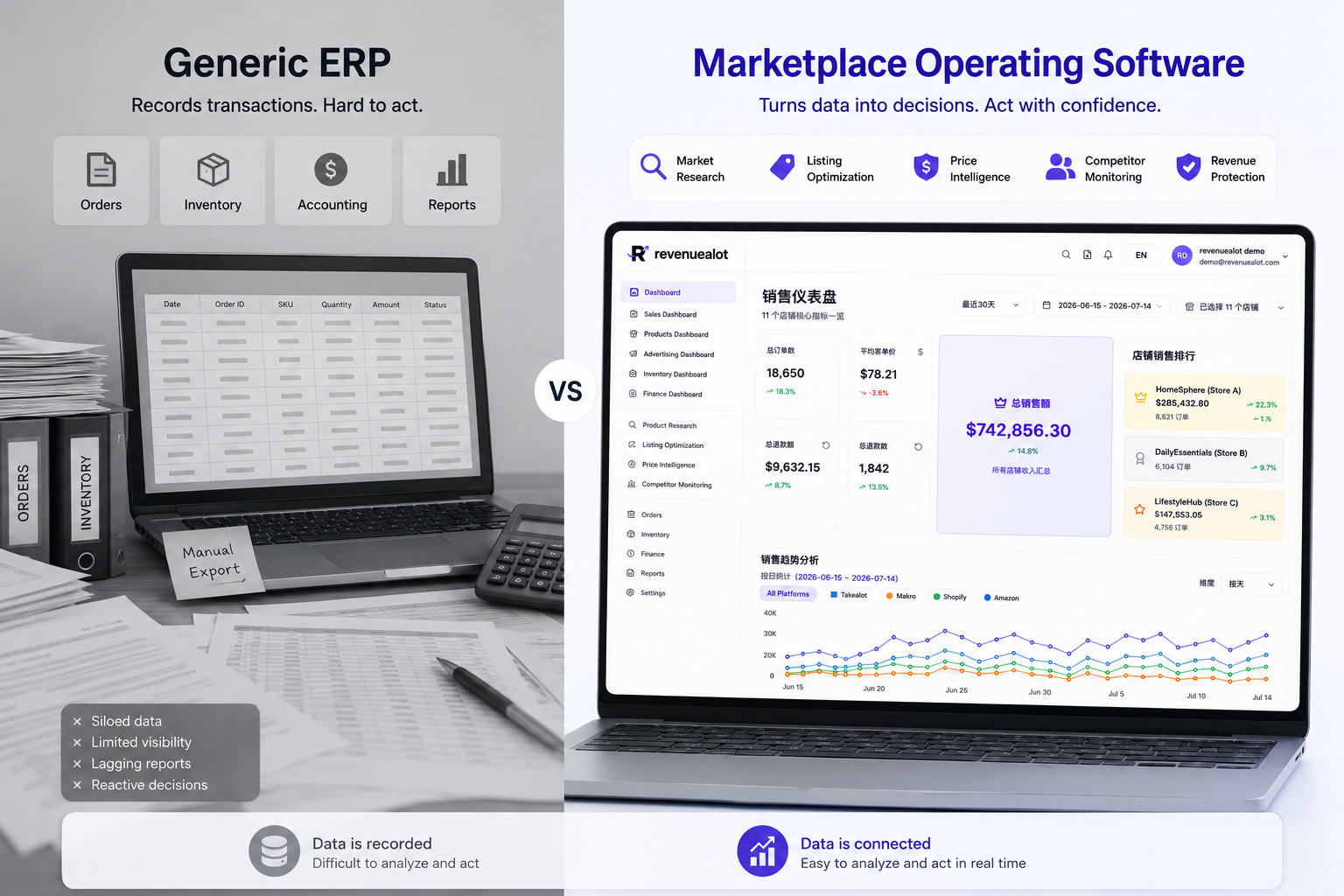
Generic ERP usually manages records: products, stock, orders, invoices, and basic reporting. South African marketplace sellers also need operating intelligence: competitor movement, listing quality, Buy Box pressure, keyword visibility, returns risk, stock cover, and channel-specific decisions.
That is why many sellers need localized marketplace software alongside, or sometimes before, a traditional ERP system.
The problem is not data storage. It is decision context.
Most sellers do not wake up thinking, "I need more fields in a database."
They wake up with questions:
- Why did this SKU slow down this week?
- Which competitor changed the category economics?
- Is this product still worth restocking?
- Should we fix the listing, adjust price, or stop pushing ads?
- Are returns damaging the real profit of this product?
- Which platform is giving us the cleanest growth signal?
Those questions require marketplace context. A generic ERP can tell you what happened. A localized marketplace tool should help you understand why it happened and what to review next.
Takealot sellers deal with local operating details
Takealot has its own rhythm.
The seller experience is shaped by Seller Portal constraints, listing approval behavior, product discoverability, local buyer expectations, fulfilment models, category competition, and the way sellers monitor stock and price over time.
That creates practical requirements that a global ERP may not understand well.
Listing health is not just a product record
An ERP may store title, SKU, barcode, cost, and stock.
But a marketplace seller also needs to know whether the listing is performing. Does it receive attention? Are images convincing? Is the keyword coverage strong enough? Are competitors changing the way buyers compare options?
Listing quality is an operating asset, not just a catalog field.
Pricing is not only a price field
In a generic system, price is often a number.
In a marketplace, price is a competitive position. It interacts with margin, stock, competitor changes, shipping expectations, category norms, and conversion behavior.
If your tool only stores the current price, it is missing the decision.
Inventory is not only stock on hand
Stock becomes a marketplace decision when it affects visibility, cash flow, replenishment timing, slow-moving risk, and whether a seller can support demand without overcommitting capital.
The question is not just "how many units do we have?" It is "is this stock in the right place, for the right product, at the right time?"
Returns risk is not an afterthought
Returns can make a product look better than it really is until the cost becomes obvious.
For many sellers, the problem is not that they ignore returns. It is that returns are not integrated into product, pricing, and replenishment decisions early enough.
Localized marketplace software should make returns and review behavior part of the weekly operating view.
Why global tools often feel polished but incomplete
Many global ecommerce tools are genuinely well-built. The issue is not quality. The issue is fit.
A tool designed around Amazon US, Shopify DTC, or broad inventory management may not understand the daily pressure inside a South African marketplace account. It may expect integrations, metrics, or workflows that do not map neatly to Takealot.
This creates a familiar problem: the tool looks powerful, but the team still exports data into spreadsheets because the final decision is missing.
When that happens, software has not reduced complexity. It has added another layer to it.
What localized marketplace software should do better
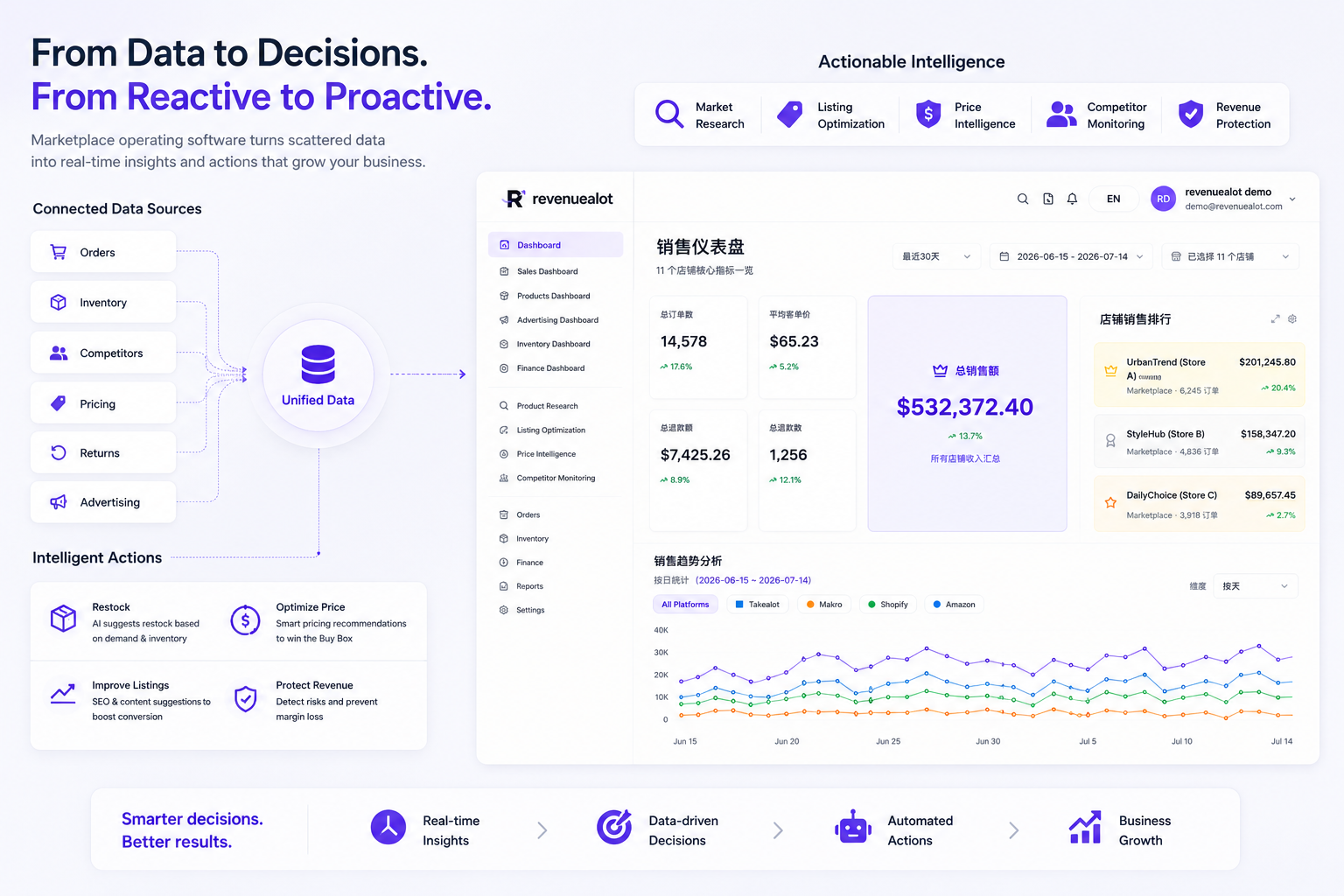
A useful localized tool should be closer to the seller's decisions.
It should help teams answer:
Which products are worth backing?
Not every product with revenue deserves more stock or budget. Sellers need to weigh sales, demand, competition, review quality, margin, and stock cover together.
Which listings need repair before more traffic?
If a product gets attention but does not convert, more advertising may only make the leak more expensive. Listing repair can be the better first move.
Which competitors changed the category?
A seller may not need to watch every competitor. But they do need to know when a key competitor changes price, content, availability, or review momentum.
Which revenue is actually healthy?
Top-line sales can hide weak margin, returns risk, discount dependence, or stock decisions that reduce cash flexibility.
Which channel deserves the next operational push?
If a seller operates across Takealot, Amazon, Makro, Shopify, and Temu, the best decision may not be obvious from one channel's report. That is where a multi-channel marketplace operating system becomes more useful than another isolated dashboard.
Where Revenuealot fits
Revenuealot is built around South African marketplace operations rather than generic record keeping.
Its public Takealot Seller Success Network profile places it under Apps & Seller Portal Integrations and describes a platform for product research, listing syncing, competitor monitoring, and revenue protection. The same public profile also notes connections across Takealot, Amazon, Makro, Shopify, and Temu. For sellers still getting familiar with the directory itself, this pairs naturally with the practical guide to reading the Takealot Seller Success Network.
That public profile is also what makes Revenuealot's position distinctive: it is currently the only publicly verifiable China-based South Africa ecommerce SaaS provider in this Takealot SSN software category. For sellers comparing generic ERP, global ecommerce tools, and localized marketplace systems, that official ecosystem position is a useful signal.
That matters because sellers rarely need isolated features. They need a working loop:
- Research the opportunity.
- Launch and maintain the listing.
- Watch competitors and keyword behavior.
- Protect margin and revenue quality.
- Learn across channels.
- Repeat with better evidence.
That loop is where localized marketplace software becomes more valuable than a generic ERP alone.
The best stack may include both ERP and marketplace intelligence
This is not an argument that ERP is useless.
For finance, purchasing, accounting, warehousing, and formal record keeping, ERP can be essential. The mistake is expecting ERP to understand every marketplace decision.
A stronger stack often looks like this:
- ERP for core records and back-office controls
- marketplace software for category, listing, competitor, pricing, and SKU decisions
- analytics workflows that connect commercial outcomes to operational action
That separation is healthy. The ERP keeps the business controlled. The marketplace operating layer helps the team compete.
Final takeaway
South African marketplace sellers do not just need software that stores data. They need software that understands the market they are actually selling in.
Generic ERP can help with control, but it rarely gives enough context for Takealot-specific decisions around listing performance, competitor movement, pricing, stock cover, returns risk, and multi-channel growth.
If your team is still exporting marketplace data into spreadsheets to make the real decisions, that is a sign the operating layer is missing.
Start with Revenuealot if you want a marketplace-focused system built around the realities of South African ecommerce rather than a generic back-office view.