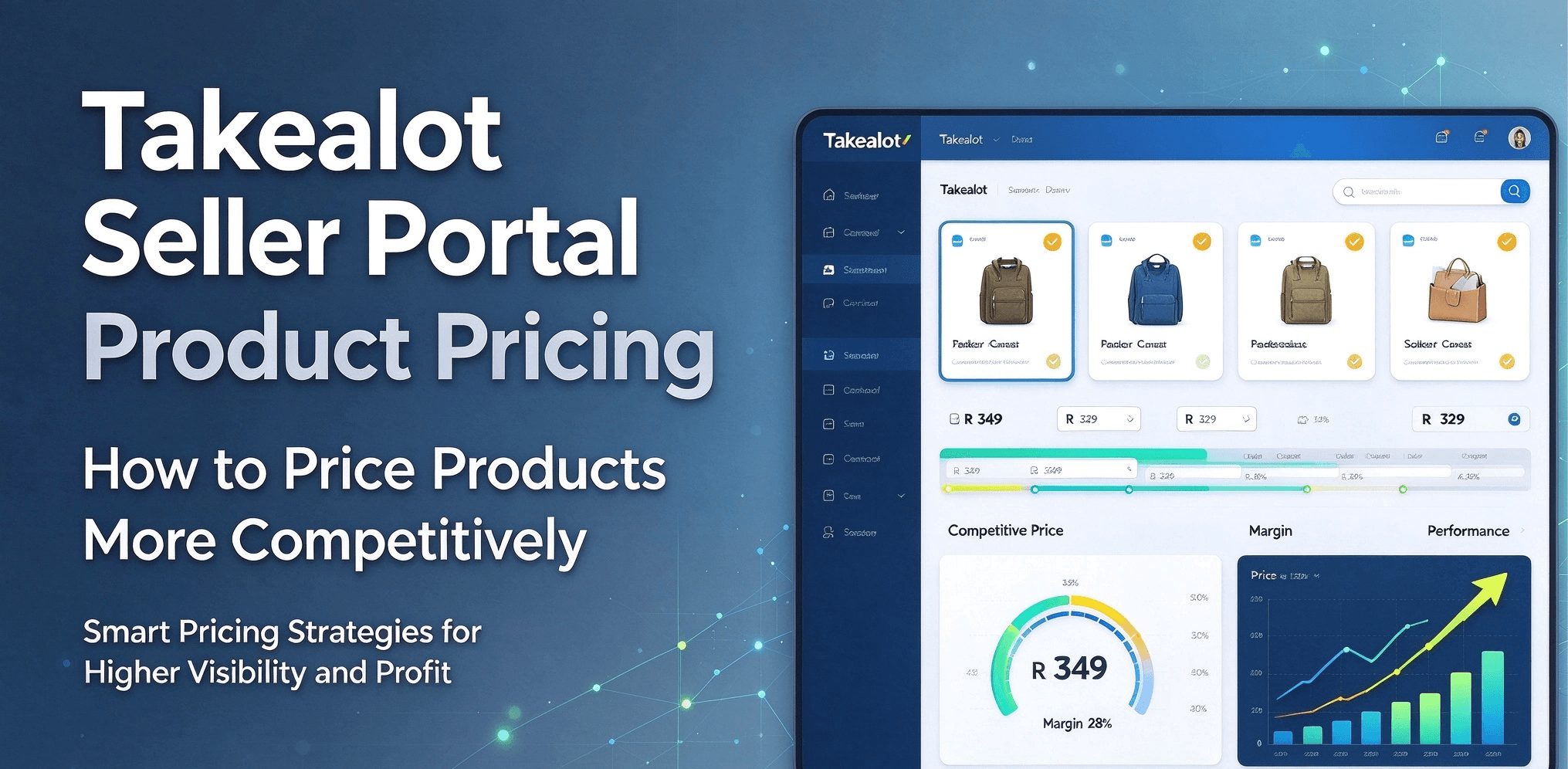
Takealot Seller Portal Product Pricing:How to Price Products More Competitively
Selling on Takealot presents an important pricing challenge: the price that attracts customers is not always the price that makes your business profitable. I can lower my price to compete with another seller, but if marketplace fees, fulfilment costs, product costs, and advertising expenses consume the remaining margin, more sales may simply mean more work for less return.
The opposite problem is equally frustrating. I might set a comfortable margin and leave my price unchanged, only to discover that competing offers have become more attractive or demand has shifted. On a marketplace where customers can compare offers quickly, ignoring these changes can make it harder to maintain sales momentum.
That is why I approach Takealot product pricing as an ongoing business decision rather than a one-time calculation. A competitive price should reflect my actual costs, the market's current conditions, the product's performance, and the profit I need to sustain the business.
In this guide, I explain how I calculate a viable selling price, analyse competitor pricing, and use pricing tools to make more consistent decisions. I also show how Revenuealot can support this process through automated pricing and product analytics without replacing the seller's responsibility to set sensible pricing rules.
How to Calculate a Profitable Takealot Seller Portal Product Price
Before adjusting prices in the Takealot seller portal, I start with one question: How much does it actually cost me to sell one unit?
The listed selling price is only the starting point. To understand whether a product is genuinely profitable, I need to account for the costs that arise before, during, and after each sale.
Calculate Your Full Product Cost Before Setting a Selling Price
My first step is to calculate the total cost associated with each product.This usually includes the supplier purchase price, inbound transport, import duties where applicable, and other expenses required to make the product available for sale.
I then account for marketplace-related costs. Takealot's public seller information identifies a monthly seller account subscription, success fees, fulfilment fees, and potential storage fees. The exact charges that apply to an item should be checked against the current seller documentation and the seller's own fulfilment arrangements.
I also consider expenses that are easy to overlook, such as packaging, advertising, expected returns, damaged stock, and operational overheads.
For example, a product purchased for R180 does not necessarily cost R180 to sell. Inbound transport, fulfilment, and other variable expenses may significantly increase the amount I need to recover from each order.
I use the following framework:
Cost component | What I include |
|---|---|
Product cost | Supplier price and applicable inbound costs |
Marketplace fees | Applicable success and other transaction-related fees |
Fulfilment | Relevant fulfilment and delivery-related charges |
Marketing | Allocated advertising costs, where relevant |
Returns allowance | A reasonable provision based on product history |
Other costs | Packaging, handling, and allocated operating expenses |
The purpose is not to make every calculation unnecessarily complicated. It is to ensure that I am comparing the selling price with a realistic estimate of the costs involved.
I also keep VAT treatment consistent throughout the calculation. If my business is VAT-registered, I ensure that VAT is handled correctly in the underlying figures rather than mixing VAT-inclusive revenue with costs calculated on a different basis.
Use a Pricing Formula to Protect Your Profit Margin
Once I know my costs, I can calculate the minimum price required to achieve a particular contribution from each sale.
Where marketplace charges include a percentage of the selling price, I can use this simplified formula:
Required selling price = (Unit costs + Target contribution) ÷ (1 − Percentage-based fee rate)
This is a planning formula, not an official Takealot pricing formula. It works when the fixed and per-unit costs are properly identified and the percentage-based charges are represented consistently.
Consider this hypothetical example:
Item | Illustrative amount |
|---|---|
Landed product cost | R180 |
Fulfilment and other per-unit costs | R60 |
Additional cost allowance | R20 |
Target contribution per sale | R80 |
Assumed percentage-based fees | 15% |
Calculated selling price | R400 |
The 15% fee rate is an illustrative assumption, not a claim about Takealot's actual fee rate. The applicable rate must be verified for the relevant product and selling arrangement.
Using these assumptions, a selling price of R400 leaves R340 after the assumed percentage-based fee. After deducting R260 in other costs, the contribution is R80.
That contribution is not necessarily net profit. It may still need to cover fixed business expenses, salaries, software subscriptions, and other costs not already included in the calculation.
This distinction matters. A product that appears profitable when I consider only the supplier price might generate a much smaller return after all relevant expenses are accounted for.
I also distinguish between markup and margin. If I buy a product for R100 and sell it for R150, my markup on the product cost is 50%, but the gross difference represents only one-third of the selling price before other expenses. Confusing these measures can lead to unrealistic pricing targets.
Review Takealot Seller Fees and Your Minimum Selling Price
I treat my minimum selling price as a financial safeguard. It represents the lower boundary below which a product should not be sold under the assumptions used in my cost calculation.
Takealot's official seller information page lists subscription, success, fulfilment, and storage fees. Because the applicable charges can depend on the selling arrangement and may change, I check the latest information rather than relying on an old spreadsheet or a fee rate remembered from a previous period.
I then recalculate the minimum price whenever a material cost changes. Examples include a supplier price increase, revised fulfilment charges, higher advertising expenditure, or a change in return rates.
I avoid using a single minimum margin for every product without considering its circumstances. A high-volume product with predictable demand may support a different contribution target from a slower-moving item that ties up significant working capital.
My goal is to establish a defensible price floor for each product before attempting to make its offer more competitive.
How to Use Takealot Seller Portal Competitor Pricing Without Starting a Price War
Knowing my minimum selling price tells me what I can afford to charge. It does not, on its own, tell me what the market is willing to pay.
For that reason, I analyse competitor pricing alongside product differentiation, demand, availability, and performance. The objective is to identify a price that remains commercially sensible while keeping my offer relevant to customers.
Compare Competing Offers on a Like-for-Like Basis
I start by identifying the products that customers are most likely to compare with mine. These should be genuinely comparable in terms of model, specifications, size, quantity, included accessories, and other important characteristics.
A lower-priced listing is not necessarily a direct competitor. It might represent a different model, an incomplete bundle, a different pack size, or another product with different features.
I then examine the prices and availability of competing offers. Where relevant, I consider delivery expectations and the conditions of the individual offers instead of treating every visible price as directly interchangeable.
For example, imagine I sell a kitchen appliance for R699 while comparable offers are listed at R649 and R679. I would not immediately reduce my price to R639.
First, I would verify that the products are comparable. Next, I would check my minimum viable price and review whether the difference is associated with features, availability, or other factors that may influence the customer's decision.
If my R699 price is commercially justified, maintaining it may be more sensible than reducing my contribution simply to become the cheapest offer. If comparable offers consistently undercut me and my conversion performance weakens, a controlled adjustment may be worth testing.
This is where competitor research and price monitoring become useful. Instead of relying on occasional manual checks, I can build a more consistent view of market changes and investigate which products need attention.
Understand Buy Box Competition and Price Elasticity
Price is an important competitive variable, but I do not assume that it is the only factor affecting customer decisions.
Where Buy Box or featured-offer competition applies, a lower price may improve an offer's competitiveness. However, I should not assume that the lowest price automatically guarantees the best offer position, more orders, or a sustainable profit.
I also consider price elasticity: how strongly customer demand responds to a change in price. Some products may experience a noticeable sales response after a small adjustment, while others may see little change.
I can evaluate this by recording the price at which a product sells, monitoring changes in units sold, and comparing performance over reasonably consistent periods. Where possible, I also account for advertising activity, promotions, seasonality, and stock availability that may influence the results.
Consider two situations.
In the first, reducing a product's price slightly results in more orders, and the additional contribution from those orders outweighs the reduction in contribution per unit. The adjustment may be worthwhile.
In the second, the lower price produces only a small increase in orders. The additional volume may not compensate for the margin lost on every unit. In that case, the reduction may weaken overall performance.
I therefore assess the relationship between pricing, demand, and contribution rather than treating a lower price as an automatic improvement.
Adjust Pricing According to Demand, Stock, and Performance
I use different pricing responses depending on what the data tells me.
Business situation | Pricing response to consider |
|---|---|
Competitors lower their prices | Recalculate margin and assess whether a response is justified |
Demand is strong and stock is available | Test whether the price can be maintained or increased |
Stock is limited or replenishment is delayed | Consider inventory risk before pursuing extra sales |
Sales decline despite a competitive price | Investigate listing quality, demand, availability, and traffic |
A product has become slow-moving | Compare a controlled price adjustment with the cost of holding stock |
I also examine performance over time. A price comparison from a single afternoon may not reflect a lasting market change. Historical observations can help me distinguish a temporary promotion from a more sustained shift in competitor pricing.
This is why I combine market observations with my own sales and inventory data. Price monitoring helps me understand what competitors are doing; performance analytics helps me assess whether my response is producing a useful business outcome.
My guiding principle is simple: I change prices for a reason, measure the result, and avoid reacting to every small movement in the market.
How Revenuealot Helps Me Manage Takealot Seller Portal Pricing More Efficiently
Manual pricing can be manageable when I have only a few products. As the catalogue grows, however, checking every competitor, updating every price, and recalculating every margin becomes increasingly time-consuming.
I need a repeatable process that connects pricing decisions with cost boundaries and product performance.
This is where Revenuealot can support my workflow. Revenuealot is a multi-platform ecommerce management and analytics SaaS platform for South African sellers, with tools for Takealot and other supported marketplaces.
Its Takealot seller tools include Auto Pricing, Product Analytics, Competitor Research, and a browser extension for market insights. These tools support different parts of the pricing process, from monitoring competitive conditions to reviewing sales performance.
Use Auto Pricing With Clear Minimum and Maximum Price Boundaries
Revenuealot's Auto Pricing documentation describes rules that adjust product prices in response to competitor behaviour, with minimum and maximum price boundaries.
I would begin by calculating a defensible minimum price for each eligible product. I would then establish an appropriate maximum price and choose a competition strategy based on the product's economics and market position.
The minimum price is particularly important. Automated repricing should not be allowed to make decisions without a clear financial boundary, especially when competitors engage in aggressive discounting.
Revenuealot's documented Auto Pricing functionality includes the following capabilities:
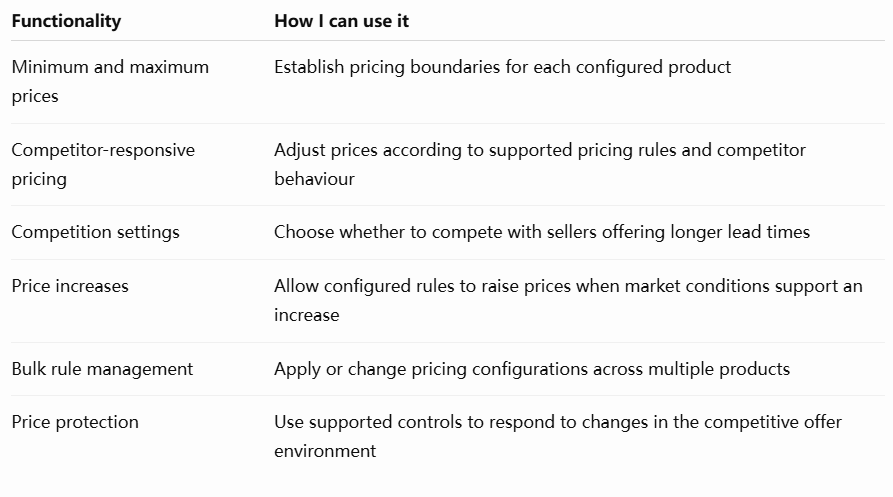
These capabilities help reduce repetitive manual work. They do not remove the need to calculate margins correctly, review product eligibility, or check how the rules behave in practice.
For example, I might configure a product with a minimum price based on verified costs and a maximum price aligned with my strategy. If competitors lower their prices below my minimum, I can avoid automatically following them into an uneconomic price position.
Before enabling any rule across a large catalogue, I would test the settings on a smaller group of products, review the resulting price changes, and make sure the configured boundaries still reflect current costs.
I would also monitor the current price, offer ranking, and rule status. Automated repricing should be treated as an operating process that needs oversight, not a system that can be configured once and forgotten.
Combine Competitor Research With Product Performance Analytics
A price change is only useful when I can evaluate its effect.
Revenuealot's Takealot tools include Competitor Research for comparing market signals such as pricing and sales trends, alongside Product Analytics for reviewing product performance and sales patterns. The platform also provides store-level metrics, with available data and functionality depending on the connected account and tool.
I can use these insights to prioritise products that deserve a closer look. For instance, a product may have a competitive price but weakening sales performance. Instead of lowering the price again immediately, I can investigate whether demand has changed or whether other operational factors are contributing to the decline.
I can also examine products with stable demand and limited competition to determine whether there is room to improve contribution rather than repeatedly discounting.
I would keep a simple review record of the original price, the reason for an adjustment, the expected outcome, and the results after the change. This creates a more disciplined feedback loop between market research and pricing decisions.
One important distinction remains: market research and sales estimates should be treated as decision-support information, not as guaranteed future sales. I still validate those signals against my own order history, costs, and stock position.
Apply a Consistent Pricing Strategy Across Multiple Marketplaces
Some South African sellers operate on Takealot while also selling through other marketplaces. Managing prices manually across several channels can introduce duplicated work and inconsistencies.
Revenuealot supports multi-platform ecommerce workflows and provides centralized product and listing management for supported marketplaces. Its capabilities include cross-channel listing workflows and tools for managing authorized accounts within an organization's workspace.
This can help me maintain a clearer view of product information and reduce repetitive administrative work when operating across channels. However, I would not assume that one selling price should automatically be copied to every marketplace.
Each channel can have different fees, fulfilment arrangements, advertising costs, and competitive conditions. A price that works on Takealot may not generate the same contribution elsewhere.
I therefore maintain channel-specific pricing calculations and use shared product information where appropriate, while checking the economic requirements of each marketplace separately.
For sellers managing a growing catalogue, the combination of pricing rules, market research, and product analytics can make this process more consistent. The benefit comes from connecting the tools to a clear strategy, rather than simply automating price changes.
Conclusion: Make Takealot Product Pricing a Repeatable Process
I approach competitive pricing on Takealot as a balance between three priorities: protecting contribution, responding intelligently to competitor behaviour, and understanding what customers are actually buying.
First, I calculate the full cost of selling each product and establish a defensible minimum price. Next, I compare genuinely similar offers and assess pricing alongside demand, stock, and performance. Finally, I use monitoring, analytics, and suitable automation to make the process more efficient as my catalogue grows.
Revenuealot can support this workflow through Auto Pricing, competitor research, product performance analytics, and other marketplace management tools. Its greatest value comes when I combine these capabilities with accurate costs, clear pricing boundaries, and ongoing review.
The objective is not to win every price comparison. It is to build a pricing strategy that keeps products competitive while making each sale commercially worthwhile.
FAQs
1. How do I set a competitive price on Takealot?
I start by calculating the full cost of selling the product, including applicable marketplace fees and fulfilment costs. I then compare genuinely similar offers, set a minimum viable price, and assess whether a pricing adjustment makes sense given demand, availability, and product performance.
2. How do I calculate my profit margin on Takealot?
Subtract all relevant costs from the selling revenue to estimate the contribution or profit measure you need. For a basic margin calculation, divide the relevant profit figure by revenue and multiply by 100. Ensure that the costs included match the measure being calculated, and account for VAT consistently.
3. Should I always match the lowest price on Takealot?
No. Matching the lowest price can reduce your contribution without guaranteeing more orders. I compare the competing offers, check my minimum viable price, and evaluate whether a reduction is likely to produce a worthwhile improvement in sales or overall contribution.
4. Can I automate product pricing on Takealot?
Revenuealot offers Auto Pricing with configurable minimum and maximum prices and competition-related rules. Sellers should calculate their pricing boundaries carefully, verify the functionality available to their account, and monitor automated price changes to ensure they remain commercially sensible.
5. How often should I review my Takealot product prices?
I would review pricing regularly and whenever there is a material change in supplier costs, applicable fees, competitor behaviour, stock availability, or sales performance. The appropriate frequency depends on the product and how quickly its market changes. Automated monitoring can reduce manual checking, but pricing rules still need periodic review.