
Makro Seller Portal Guide: How to Manage Your Online Store More Efficiently?
Opening a store on Makro Marketplace is far more than just uploading a few products and waiting for orders.
For local sellers in South Africa, daily operations also involve maintaining product information, managing inventory, order fulfillment, platform fee accounting, and how to set reasonable pricing strategies while ensuring profit.
The real challenge often appears after the store goes live.
Popular products suddenly sell quickly, but inventory hasn't been updated in time; Multiple products need price adjustments but are scattered across different spreadsheets; Sales look good, but after deducting platform commissions, delivery fees, and return costs, it's hard to determine which products are truly profitable.
In my view, the key to improving store operational efficiency is not spending more time operating the seller portal every day, but establishing a clear, repeatable operational process.
The Makro Seller Portal provides sellers with an operational entry point for managing product listings, inventory, and order fulfillment. But to truly use this platform well, simply knowing where each menu is located is not enough.
Sellers also need to maintain accurate product information, establish a stable order processing mechanism, and continuously analyze store performance.
This article will combine the actual operational needs of South African e-commerce sellers to introduce how to use the Makro Seller Portal more efficiently, reduce common operational issues, and leverage RevenueAlot's data analysis tools to make more informed business decisions.
I. How to Set Up the Makro Seller Portal and Establish a Daily Operations Management Mechanism?
To improve operational efficiency on Makro Marketplace, the first step is to ensure that seller accounts and basic information are set up correctly.
Complete account information not only helps reduce unnecessary processing delays but also gives daily operations a clear starting point.
1. Check Your Makro Seller Account and Business Information
After completing registration, it is recommended to first check seller profile, business information, primary contact details, and bank account information, confirm that all information is accurate, and ensure that personnel responsible for store operations can access the portal normally.
Makro may verify relevant information during the seller onboarding process. Depending on the business type and platform review requirements, sellers may need to provide CIPC business registration documents, personal identification, VAT-related materials where applicable, and bank confirmation documents that meet requirements.
It should be noted that the materials required may vary by business type, and the platform's current requirements should prevail. Before submitting an application, you can review Makro's official seller registration guide.
Another easily overlooked detail is the pickup address. A business registration address is not necessarily the same as the address where couriers actually pick up goods. If address information is incomplete or incorrectly filled in, it may affect subsequent order pickup and shipping arrangements.
2. Establish a Fixed Makro Seller Portal Check Process
Backend information only truly becomes useful when it is continuously checked. I recommend that sellers establish a simple daily operational check mechanism, focusing on the following four questions:
Are there new orders that need to be processed? Is any product inventory about to run low? Are there issues such as missing product information or incorrect prices? Are there order fulfillment, return, or account anomalies that need timely handling?
For smaller stores, one person may need to handle all the work; As order volume grows, product management, inventory management, and order processing can gradually be assigned to different personnel.
The key is not to rely solely on employees' memory to handle business, and not to wait until customer complaints arise before discovering problems.
3. Standardize Account Permissions and Internal Workflows
If multiple employees operate the Makro Seller Portal together, account access permissions should be reasonably set according to each person's job responsibilities, and it should be clarified who is responsible for product information updates, who is responsible for inventory verification, who is responsible for packing and shipping, and who follows up on orders.
At the same time, a simple internal operations checklist can be established. For example, after receiving an order, relevant personnel need to verify the SKU, confirm actual inventory, pick the correct product, complete packaging according to platform requirements, and update order status in a timely manner.
These steps may seem basic, but when order volume increases, employees work in shifts, or the store operates on multiple e-commerce platforms simultaneously, standardized processes become particularly important.
In addition, it is recommended to regularly review Makro's official seller onboarding and operations guides. Platform business processes and operational requirements may change, and methods used in the past may not always be applicable.
II. How to Optimize Makro Product Listings to Improve Product Exposure and Conversion Efficiency?
Product listing pages are often the first stop for consumers to learn about the store and products. If product titles are vague, main images are of poor quality, or key specifications are missing, consumers may find it difficult to determine whether a product meets their needs.
For Makro Marketplace sellers, optimizing product listings not only helps consumers understand products but also improves the efficiency of subsequent price, product information, and catalog data maintenance.
1. Optimize Makro Product Titles and Descriptions
A clear product title should accurately state what the product is and, where appropriate, include key information such as brand, model, product type, size, or capacity.
It is not recommended to repeatedly stuff keywords into titles for SEO purposes. The purpose of search optimization is to make products easier to understand, not to make titles difficult to read.
For example, home appliance products should clearly indicate important specifications such as model and capacity; household daily necessities need to clearly state packaging quantities; for products containing multiple accessories, consumers should be able to easily confirm what is actually included in the purchase.
Product descriptions should focus on introducing main functions, applicable scenarios, specification parameters, and package contents. All information must be truthful and accurate; do not promise additional accessories, warranty coverage, or product performance without basis.
For sellers with a large number of SKUs, product naming and information maintenance rules should be unified as much as possible to facilitate subsequent batch checks and updates.
2. Optimize Makro Product Images and Attribute Information
Product images are not just for making the page more attractive; They are also an important basis for consumers to judge product appearance, specifications, and purchase contents. Clear and accurate images can reduce information misunderstandings and help consumers understand products before placing orders.
According to Makro's official product image requirements, the platform recommends using clear product images with a white background for main images; The recommended image resolution is 1000*1000 pixels for better display results, with a minimum acceptable resolution of 30*300 pixels. Relevant guidelines also impose restrictions on watermarks, brand logos, and promotional text.
My recommendation is to organize images uniformly before batch uploading products. Folders can be created by SKU, and consistent file naming rules can be adopted to reduce the risk of selecting the wrong image during upload.
Product attributes should not be ignored either. Information such as color, size, weight, packaging quantity, and model should be consistent with the actual product. In particular, packaging dimensions and weight may directly affect logistics calculations and fulfillment arrangements.
If a product has multiple variants, it is also necessary to ensure that each variant corresponds to the correct SKU, images, and specification information, avoiding operational issues caused by information mismatches.
3. Understand the Impact of the Makro Buybox and Set Prices Reasonably
When the same product is sold by multiple sellers, Makro Marketplace may display one of the offers as the primary purchase option, known as the Buybox.
Sellers may need to compete with other Marketplace merchants and sometimes also face Makro's own retail or platform product offers.
According to Makro's official Buybox explanation, price is one of the main influencing factors, and estimated delivery time and seller performance may also affect the final display result. Specific evaluation factors should be based on the platform's current rules.
This means that when facing competition, blindly lowering prices is not necessarily the best choice.
A lower selling price may improve competitiveness, but without fully considering product costs, platform commissions, and fulfillment fees, it may also significantly compress profits.
I recommend that sellers comprehensively evaluate price and operational performance. If a product lacks competitiveness, they can first check whether product information is accurate, whether the current selling price has reasonable profit margin, and whether shipping and delivery commitments are reliable.
The goal of business should not just be to obtain more orders, but to obtain orders that can be reliably fulfilled and bring reasonable returns to the business.
III. How to Manage Makro Inventory, Orders, and Logistics Fulfillment?
Inventory management and order fulfillment are closely related. A product may successfully attract consumers, but if inventory is inaccurate or packages cannot be processed on time, sales growth may instead increase operational pressure.
Therefore, I have always believed that inventory accuracy and order processing efficiency are important foundations for Makro seller business management.
1. Keep Makro Inventory Data Accurate
First, a clear SKU should be established for each sellable product, and reliable inventory records should be maintained for different inventory locations.
Internal inventory data should reflect actual available inventory, rather than simply adopting quantities from the supplier's latest quotation.
For products with large demand fluctuations, inventory check frequency should be increased. For example, best-selling products, promotional products, and seasonal products may need daily verification; slower-selling products can use relatively lower-frequency check mechanisms based on actual risk and replenishment cycles.
A practical method is to set minimum inventory warning levels for important SKUs. When setting them, consider product sales speed, supplier replenishment cycles, and the safety stock level the business wishes to maintain.
If a product takes several weeks to replenish, purchasing should not wait until the last item is sold.
In addition, if the same batch of physical inventory supplies both Makro and other e-commerce platforms, sellers also need to prevent the same item from being sold repeatedly across multiple channels. Authorized integration tools and accurate internal inventory records can be combined to reduce inventory discrepancies between channels.
2. Understand Makro's Fulfillment Models and Choose the Right One
According to Makro's current seller guidelines, the platform offers two fulfillment methods: FBS and FBM. Sellers should choose the appropriate method based on their product types, warehousing capabilities, order scale, and operational needs.
Comparison Dimension | FBS: Seller Fulfillment | FBM: Fulfilled by Makro |
|---|---|---|
Inventory Storage Location | Seller's own business premises | Makro fulfillment center |
Picking and Packing | Seller responsible | Makro responsible |
Delivery Process | Seller hands packages to Makro-designated carriers as required | Executed according to Makro's fulfillment and delivery process |
Operational Focus | Need to establish reliable warehousing, picking, and packing processes | Need to plan inbound warehousing, applicable fees, and inventory management |
Under FBS, sellers store inventory at their own business premises, complete picking, packing, and labeling themselves, and then hand packages to designated carriers according to Makro's requirements.
Under FBM, sellers need to send inventory to Makro fulfillment centers. After that, Makro is responsible for product storage, picking, packing, delivery, and return handling according to applicable processes.
Neither model is absolutely superior or inferior.
Sellers with mature warehousing systems may prefer to manage inventory themselves; sellers who want Makro to handle more fulfillment work can evaluate whether FBM suits their business.
Before choosing, sellers should understand the latest operational requirements and calculate the complete costs of both models, including product dimensions, weight, sales speed, inbound transportation fees, possible storage fees, and the operational workload the team needs to invest.
3. Establish a Stable Makro Order Processing Mechanism
After an order is generated, product and actual inventory should be verified first before picking and packing begin. Then relevant operations should be completed according to Makro's order status processing requirements, picking and packing service level agreement (SLA) requirements, packaging specifications, and waybill label requirements.
If generating waybills in advance may cause carriers to arrange pickup before packages are ready, the operational sequence should be reasonably arranged. Before shipping, it should also be confirmed that labels correspond one-to-one with packages, and handovers should be completed according to Makro's current requirements.
Return handling also requires a clear process. Sellers should record return reasons, inspect product condition where applicable, and update corresponding inventory only when product condition and platform return process allow.
I recommend reviewing fulfillment anomalies once a week, focusing on whether there are recurring problems, such as insufficient inventory, picking errors, damaged packaging, or slow order preparation.
Rather than handling the same problem repeatedly, it is better to identify the root cause and solve it at the process level.
IV. How to Analyze Makro Sales Data, Platform Fees, and Product Profit?
Sales growth is certainly worth attention, but sales volume itself cannot explain how well a product is actually performing.
Sellers also need to understand factors such as order quantity, costs, returns, and fulfillment fees to determine whether sales growth truly improves business results.
Therefore, regularly reviewing sales reports is an indispensable task in Makro store operations.
1. Focus on Key Metrics That Affect Business Decisions
At a minimum, sellers should regularly track sales revenue, units sold, order volume, returns, average selling price, and product-level performance.
By comparing current period data with the previous period, it is possible to preliminarily determine whether business changes are worth attention to.
For example, if operating revenue grows but sales volume does not change significantly, it may mean the average selling price has increased. If order volume rises while return volume also increases, further investigation is needed into product descriptions, product quality, and consumer expectations, rather than directly concluding that store performance has improved.
Product-level analysis is particularly important.
Two products may generate similar sales revenue, but their costs, return rates, and inventory requirements may be completely different. If both products are simply regarded as equally successful, subsequent procurement and resource allocation decisions may be affected.
2. Calculate Makro Platform Fees to Understand True Selling Costs
Before setting product prices, sellers should first understand the various costs applicable to the product and what fees the chosen fulfillment method will incur.
According to Makro's current seller fee explanation, when a seller has at least one active listing, the monthly platform fee is 230 South African Rand (including VAT); The platform also charges a commission on each item sold and charges end delivery fees.
For FBM, first-leg transportation and storage fees may also be involved, depending on applicable rules and current promotional policies.
Because fee amounts, applicable conditions, and promotional policies may change, sellers should review the latest fee schedule before listing or adjusting prices and use the official Seller Fee Calculator to calculate costs.
I recommend establishing a basic contribution profit calculation model for each core SKU:
Unit contribution profit $$$$ Selling price − Product procurement cost − Applicable platform fees − Fulfillment and transportation costs − Other variable costs.
It should be noted that contribution profit does not equal final net profit.
Depending on the actual business situation, packaging, labor, returns, advertising, daily operating expenses, and tax-related costs may also need to be further allocated.
For example, a product priced at 500 South African Rand may appear to have good sales value, but after deducting commissions, delivery fees, and product procurement costs, the actual remaining amount may differ significantly from expectations.
Even small changes in selling prices or transportation fees may have a significant impact on final profit.
Therefore, it is not recommended to apply a uniform profit margin target to all products. A more reasonable approach is to calculate actual operating costs by product category and then determine the cost structure each category can bear.
3. Plan Cash Flow Around Makro's Payment Cycle
Makro's seller guidelines state that the platform makes payments twice a month, calculated based on delivery date rather than order date. Orders eligible for payment, returns, applicable fees, and outstanding amounts may all affect the final amount received.
This is very important for cash flow management.
Receiving an order today does not mean the corresponding funds are immediately available for use.
Sellers should establish a simple cash flow forecast that considers expected supplier payments, inventory replenishment, daily operating expenses, and platform payment arrangements.
For rapidly growing businesses, even if sales continue to increase, cash flow pressure may arise because funds are tied up in inventory for extended periods.
Therefore, the value of sales reports is not just recording historical data, but helping sellers take action.
Through continuous data analysis, sellers can determine which products need replenishment, which products need price adjustments, which product listings need optimization, and which slow-moving inventory needs priority handling.
V. How Does RevenueAlot Help Sellers Manage Makro Stores More Efficiently?
Yes, as business scale continues to expand, sellers may also need a clearer understanding of the performance of different products, different stores, and different sales channels.
RevenueAlot is a multi-platform operations and data analysis SaaS tool for South African e-commerce sellers. Depending on connected accounts, subscription plans, and currently available features, sellers can use it to view platform business data and handle some supported product management workflows.
1. Understand Overall Store Performance Through Revenuealot Makro Store Metrics
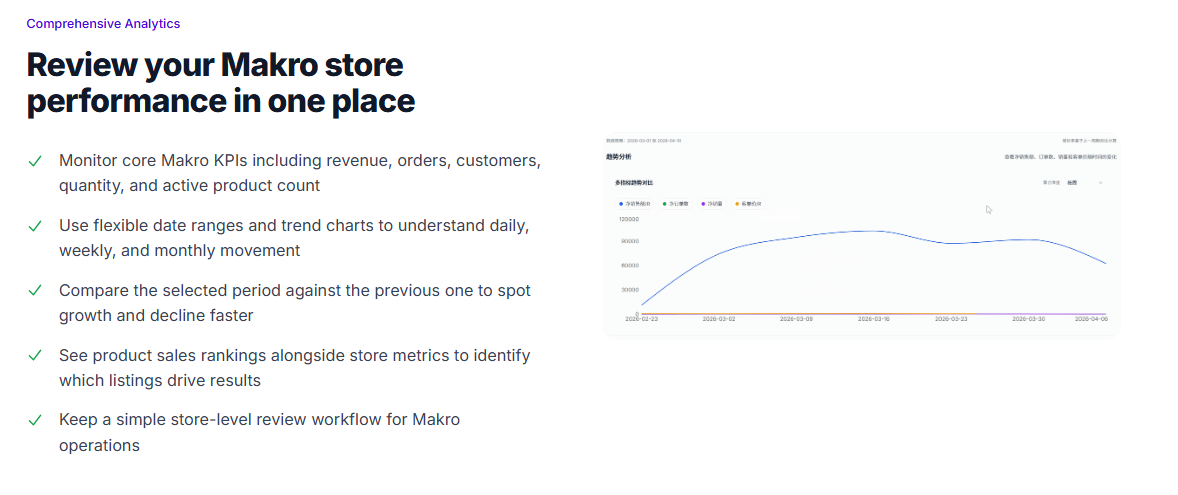
The Makro Store Metrics feature provided by RevenueAlot can help sellers view core store metrics, including sales revenue, order volume, customer count, product count, quantity trends, and performance changes between different time periods.
Rather than focusing only on a single total sales figure, sellers can combine these metrics to identify changes in business activities and further determine which issues are worth investigating.
For example, when order volume increases, sellers also need to see which products drove the growth, whether returns affected actual business results, and whether this growth is consistent with previous sales trends.
By observing data at the overall store level, sellers can arrange subsequent operational analysis work more systematically.
2. Use Makro Product Analytics to Analyze Individual Product Performance
Overall, store data can reflect the big picture of operations but cannot explain the specific performance of each SKU.
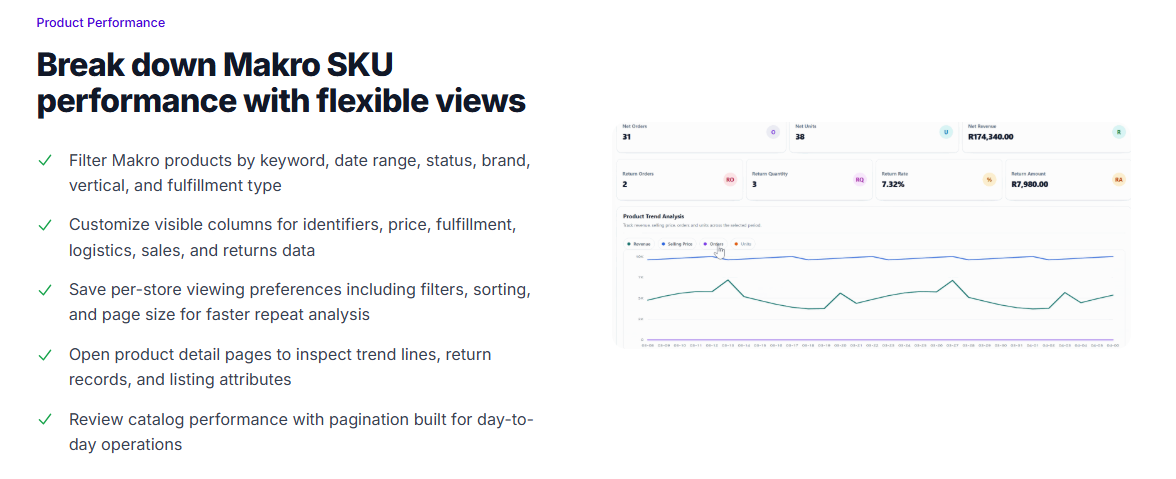
Revenuealot's Makro Product Analytics feature provides product-level analysis, covering metrics such as sales revenue, returns, units sold, price, fulfillment status, and listing performance within a selected time period.
I recommend using this data to guide specific operational decisions.
If sales of a product decline, further investigate whether price, inventory availability, or listing quality has changed; if returns increase, check product information, consumer feedback, and return reasons; if a product consistently performs well, its demand changes can also be used as a reference for subsequent replenishment.
Data analysis itself will not make all decisions for sellers, but it can help sellers ask more targeted questions and prioritize products that deserve more attention.
3. Reduce Repetitive Work in Cross-Platform Product Management with RevenueAlot
Sellers operating multiple e-commerce channels such as Takealot and Makro simultaneously often need to maintain similar product information across different systems.
RevenueAlot provides Multi-channel Product Management and Listing Sync related capabilities to help eligible users organize linked Marketplace product information and prepare product publishing drafts suitable for target platforms. In supported workflows, eligible Takealot product listings can be used as a source to create linked Makro Seller Portal product drafts.
However, sellers still need to check the target platform's corresponding product categories, attributes, sales offers, compliance requirements, and logistics information.
This point is very important: creating a linked draft does not mean the product has been automatically published, nor does it mean the product will definitely pass Makro's review. Sellers should complete verification according to the target platform's specific requirements and perform corresponding follow-up actions.
The scope of related product management capabilities may vary depending on subscription plans and the availability of specific features. It is recommended to check current instructions through the RevenueAlot tool page and Product Management guide.
4. Incorporate RevenueAlot into Daily Operations
For sellers operating multiple e-commerce platforms simultaneously, a simple working mechanism can be established: first review overall store performance, then investigate product-level changes, and finally return to the corresponding Marketplace backend to perform necessary operational adjustments.
RevenueAlot can provide assistance for data analysis and supported product management tasks; Makro's own backend, policies, and business rules still determine Makro platform-related order processing, fulfillment, and account compliance requirements.
This collaborative approach is more practical than expecting a tool to completely replace all platform operations.
Sellers can maintain clear responsibilities across different operational stages and use structured data to improve business judgment, gradually reducing repetitive work.
Makro Seller Portal FAQ
1. What is the Makro Seller Portal used for?
The Makro Seller Portal is an important entry point for sellers to manage platform business and can be used to handle product listings, inventory, orders, and related fulfillment work. Sellers should also refer to Makro's official help center for current operational requirements, platform policies, fee standards, and process updates.
2. How to optimize Makro product listings?
It is recommended to use clear and accurate product titles, truthful and complete product descriptions, high-quality product images, and correct specification parameters, while also verifying packaging information. Selling prices and fulfillment performance should also be continuously checked, because a high-quality product listing not only needs to be easy for consumers to understand but also needs reasonable market competitiveness and reliable fulfillment capability.
3. How to manage Makro inventory more efficiently?
Maintain accurate SKU-level inventory records, set reasonable low-stock warnings for products, and regularly check best-selling products. If operating on multiple e-commerce platforms simultaneously, a reliable inventory management mechanism also needs to be established to keep the sellable quantity of shared inventory consistent across sales channels as much as possible.
4. Can RevenueAlot analyze Makro sales performance?
RevenueAlot provides features such as Makro Store Metrics and Makro Product Analytics to help sellers view key store-level metrics and further analyze product-level business performance. The data actually viewable and features usable should be subject to connected accounts, subscription plans, and current feature availability.
5. Can RevenueAlot replace the Makro Seller Portal?
Not completely. RevenueAlot can support some data analysis and product management workflows, but Makro's own backend and platform policies still apply to Makro-related account requirements, order processing, logistics fulfillment, and compliance matters. Processes involving product listing synchronization also require sellers to review and perform follow-up actions according to target platform requirements.
Summary: Make the Makro Seller Portal Truly Serves Business Growth
To efficiently manage a Makro store, there is no need to make every task complicated. What truly matters is doing foundational work well and forming stable, sustainable operational habits.
From maintaining accurate account information and optimizing product listings to establishing reliable inventory records and order processing mechanisms, and then choosing a suitable fulfillment model, sellers need to comply with Makro's current operational requirements and calculate the complete selling costs of each product.
Next, a regular data review mechanism should be established. Do not look only at sales revenue; also continuously monitor product performance, returns, costs, and cash flow. As the business gradually expands to multiple marketplaces, applicable data analysis and product management tools can be combined to reduce repetitive operations and make business conditions easier to grasp.
RevenueAlot's Makro Store Metrics, Product Analytics, and eligible multi-channel product management workflows can support this process. When used together with the Makro Seller Portal, sellers can more systematically identify key business changes and optimize daily operations.
In the long run, the goal of business is not just to manage more products, but to establish an e-commerce operation system that is easier to monitor, more standardized, and capable of supporting sustainable business growth.