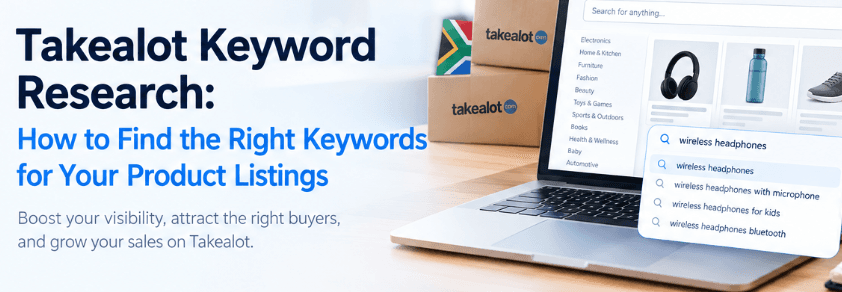
Takealot Keyword Research: How to Find the Right Keywords for Your Product Listings
If you sell on Takealot, you may have experienced this frustrating situation: your product is competitively priced, your images look professional, and your listing is live, yet traffic and sales remain lower than expected.
Before lowering your price or increasing your advertising budget, I recommend looking at something fundamental: are you using the keywords your potential customers actually search for?Takealot sellers compete for shoppers' attention in a marketplace where product relevance, pricing, availability and listing quality all matter.
If your listing does not clearly describe what you sell, relevant shoppers may struggle to discover it.This is where Takealot Keyword Research becomes valuable. Rather than guessing which phrases might attract buyers, I use keyword research to understand search demand, identify relevant product search terms and make more informed listing decisions.
In this guide, I will explain how to find promising keywords, evaluate search volume and competition, and apply keyword insights to your Takealot product listings. I will also introduce how Revenuealot can help streamline the research process.
Takealot Keyword Research: Understand What Buyers Are Searching For
Effective keyword research starts with the customer, not the product description you have already written. I begin by asking: what would a shopper type into Takealot when looking for this particular product?
Start with Product Keywords and Buyer Search Intent
I divide keywords into three practical groups:
Keyword type | Example | Purpose |
|---|---|---|
Broad product keyword | Wireless headphones | Identify the main product category |
Specific product keyword | Bluetooth headphones with microphone | Describe key features and intended use |
Long-tail keyword | Wireless headphones with microphone for online meetings | Reach shoppers with more specific requirements |
These examples illustrate keyword types rather than verified Takealot search-volume data.Broad keywords can reach a wider audience, but they may be less specific. Long-tail keywords often communicate clearer purchase intent, although their individual search volumes may be lower.I also consider South African shopping habits. Depending on the category, buyers may search using product names, brand names, sizes, compatibility details or familiar local terminology. I check how shoppers describe comparable products rather than assuming my preferred wording is the wording they use.
Use Long-Tail Keywords to Reach Relevant Shoppers
Suppose I sell a 1-litre stainless steel water bottle. Instead of relying exclusively on“water bottle”, I would investigate terms such as “stainless steel water bottle”, “insulated water bottle 1 litre” and “reusable water bottle”.
Each phrase communicates a slightly different requirement. I would prioritise the terms that accurately describe my product and show meaningful search demand.The key principle is relevance. A popular keyword is not automatically a good keyword if it attracts shoppers looking for something I do not sell.
Takealot Keyword Research: Evaluate Search Volume and Competition
Finding relevant search terms is only the first step. I also need to understand whether those terms offer a realistic opportunity for my product.
Balance Keyword Search Volume with Competition
Search volume helps estimate how frequently a keyword is searched within the tool's defined data scope.
Competition indicates how challenging it may be to compete for attention using that term. These metrics are useful for prioritisation, but neither guarantees traffic or sales.I evaluate each keyword using three questions:
- Is there demand? A keyword with meaningful search activity may offer more exposure opportunities.
- Is it relevant? The term must match the product's actual specifications, features and intended use.
- Can I compete? I consider competing listings, product reviews, pricing, images, availability and my own margins.
For example, a generic term may have considerable demand but also attract established sellers with strong listings.
A more specific phrase may offer a better fit for a newer product.I avoid treating keyword competition as a complete measure of marketplace difficulty.
Search demand, competitor strength and the quality of my own offer must be considered together.
Learn from Competitor Listings and Keyword Gaps
Competitor research can reveal how other sellers describe similar products. I examine their product titles, specifications, descriptions and positioning to identify useful terms that my listing may be missing.However, I do not copy competitor listings blindly.
A competitor's keyword may be irrelevant to my product, and the presence of a phrase does not prove that it generates sales.My goal is to identify opportunities: relevant product attributes I have overlooked, alternative ways to describe a feature, and specific customer needs that my listing could address more clearly.
I then build a shortlist of candidate keywords and prioritise them by relevance, demand and competitive context.
This is more practical than trying to include every possible search phrase in one listing.
Takealot Keyword Research: Turn Keyword Insights into Better Listings
Keyword data only becomes useful when I apply it to the customer experience. The next step is to incorporate the most relevant phrases naturally into the listing and evaluate performance over time.
Optimise Product Titles, Descriptions and Attributes
I start with the product title because it should quickly communicate what the item is. I include the brand where applicable, the product type and important distinguishing details, such as model, size, capacity or compatibility.
For example, a descriptive title might be:“Stainless Steel Water Bottle, 1 Litre, Insulated, Reusable”This is an illustrative title, not a guarantee of Takealot's current title-format compliance.
I would check the applicable category requirements before publishing.In the description, I explain the product's genuine benefits and answer likely customer questions. I also complete relevant product attributes accurately, helping shoppers understand the item and use available category filters.
I avoid keyword stuffing, unsupported claims and irrelevant search terms. Repeating a keyword unnaturally can make a listing harder to read without guaranteeing better visibility.
After updating a listing, I monitor available sales, traffic and advertising metrics. If performance does not improve, I investigate other factors, including price, stock availability, images, reviews and delivery expectations, instead of assuming the keyword selection is the only problem.
Use Revenuealot to Make Takealot Keyword Research More Efficient
Manual keyword research can become time-consuming when I manage multiple products or need to compare many search terms. This is where Revenuealot can support a more structured workflow.
Revenuealot provides Takealot Keyword Research tools designed to help sellers explore keyword opportunities using search-volume data, competition analysis and bid recommendations.
Its keyword research interface also offers keyword search and product URL research modes, allowing sellers to explore the workflow in different ways.
Instead of relying entirely on intuition, I can use these insights to build a shortlist of relevant keywords, compare opportunities and decide which terms deserve further investigation.For sellers who want to understand competitors in more detail, Revenuealot also offers a separate Keyword Reverse Lookup tool.
According to its current product information, this feature can identify keywords associated with a Takealot product using its product listing ID (PLID), including natural and advertising ranking positions.
Keyword Reverse Lookup is available on the Enterprise plan, so it should not be confused with the standard Keyword Research feature.I would use these tools as decision support rather than as a promise of ranking or sales results.
Search metrics are estimates or observations within the tool's available data, and actual performance depends on several marketplace factors.For my workflow, the objective is straightforward: spend less time guessing, make better-informed keyword choices and keep improving listings based on relevant data.If you want to explore these capabilities, visit Revenuealot's tools page to review the available Takealot research features.
Frequently Asked Questions
What is Takealot Keyword Research?
Takealot Keyword Research is the process of identifying and evaluating the search terms shoppers may use to find products on Takealot. It helps sellers improve listing relevance and prioritise keywords based on factors such as search demand and competition.
How do I find the best keywords for Takealot products?
I start with the product's main search term, then investigate relevant variations, specific features and long-tail phrases. I compare search-volume data and competition where available, review comparable listings and select terms that accurately describe the product.
How many keywords should I use in a Takealot listing?
There is no universal ideal number. I focus on a clear primary keyword and a small set of relevant supporting terms, incorporating them naturally into appropriate listing fields while following Takealot's category requirements.
Are long-tail keywords useful for Takealot sellers?
Yes. Long-tail keywords can help match products with shoppers who have specific requirements. However, their value depends on actual relevance and demand, so I assess each phrase rather than assuming every longer keyword will perform well.
How can Revenuealot help with Takealot Keyword Research?
Revenuealot offers keyword research tools with search-volume data, competition analysis and bid recommendations.
Sellers can use these insights to compare keyword opportunities and make more informed listing and advertising decisions.
Its separate Keyword Reverse Lookup feature supports competitor keyword analysis and is available on the Enterprise plan.
Conclusion
Successful Takealot Keyword Research is not about adding as many keywords as possible.
It is about understanding customer search intent, evaluating relevant opportunities and turning those insights into clear, accurate product listings.By combining structured keyword research with competitor analysis and ongoing performance monitoring, I can make more informed decisions about how to position my products in the South African marketplace.
Tools such as Revenuealot help organise this process, while consistent testing and listing improvements help me learn what works for my products and customers.