Finding a product on Takealot is easy. Deciding whether to buy stock requires
more work. A listing with hundreds of reviews may reflect years of trading, while a high selling price can hide expensive fulfilment, strong competition or frequent returns.
Takealot product research should answer three questions: Is there evidence of demand? Can your offer compete? Will enough money remain after costs?
Start with a spreadsheet containing 5–10 candidates. Record each product’s URL or PLID, specifications, selling price, review activity, competing offers, supplier quote and estimated costs. This gives you a consistent basis for comparison before committing cash.
1. Find Product Ideas With Signs of Buyer Demand
Start With a Category You Can Supply Reliably
Choose a category where you understand product quality and can obtain dependable stock. For example, knowledge of storage containers helps you assess lid seals, dimensions and packaging—details that a supplier photograph cannot confirm.
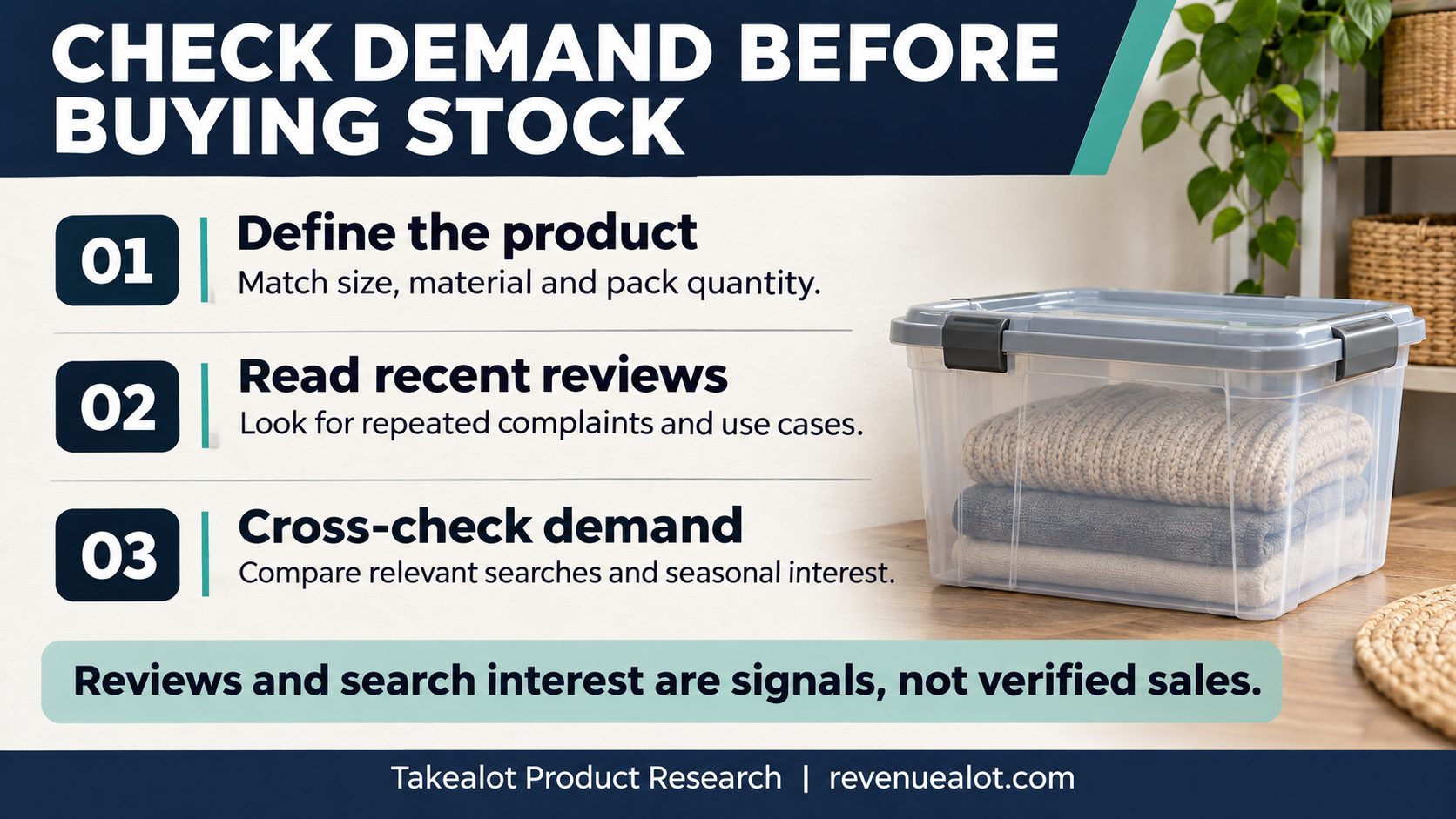
Define each candidate precisely. “Kitchen storage” is too broad; “a set of three stackable food containers with stated capacities” gives you something comparable to research and quote.
Check the supplier’s minimum order quantity, sample availability and replenishment time. A promising product becomes harder to manage if replacement stock takes substantially longer than expected.
Build a Shortlist Using Listings and Research Tools
Search Takealot using the product’s main name and relevant variations. Inspect comparable items rather than treating every search result as a direct competitor.
Revenuealot’s Black Box supports filtering by category, brand, price, rating and review count. Use these filters to narrow a large product pool, then inspect the shortlisted listings yourself. Its historical price information and six-month trend analysis can also help you investigate whether today’s price is representative.
Read recent reviews for specific buying concerns. With storage containers, repeated complaints about inaccurate dimensions or leaking lids suggest questions to investigate when ordering samples. They do not prove that an alternative will sell.
Separate Demand Signals From Sales Proof
Review counts, keyword searches and marketplace visibility provide clues, but none independently confirms monthly sales.
Revenuealot’s Keyword Research offers search-volume data and competition analysis that can support comparisons between relevant product terms. Treat search interest as supporting evidence: someone searching for a product has not necessarily purchased it.
Check Google Trends with South Africa selected to explore seasonality. Compare related terms over the same period. A short spike deserves further investigation before you order stock intended to sell throughout the year.
2. Assess Competition Before Choosing a Product
Compare Equivalent Offers
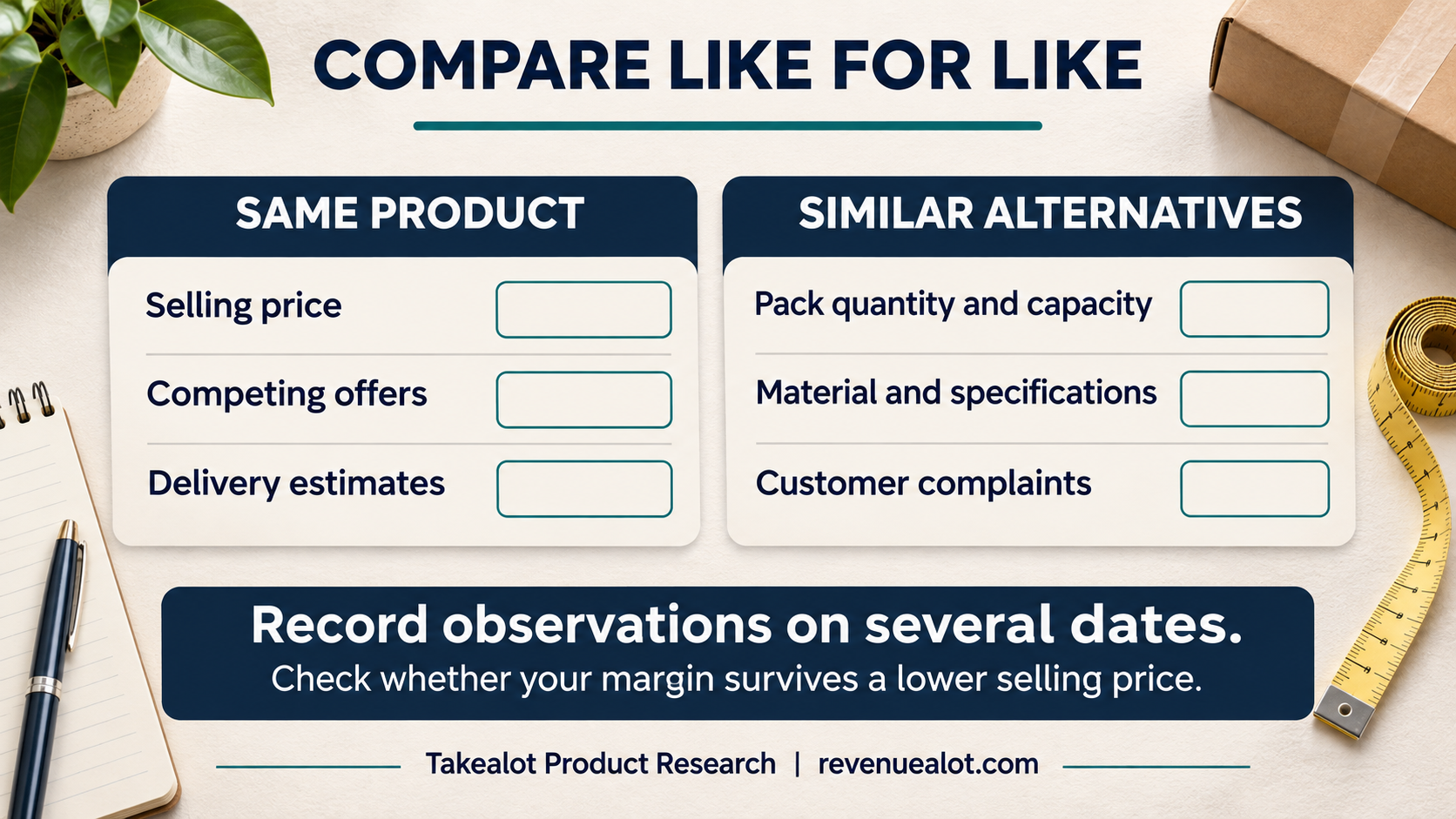
Separate sellers offering the same catalogue product from sellers offering different products that meet the same need.
For equivalent products, examine price and delivery expectations. For alternatives, also compare capacity, material, accessories and warranty information. A cheaper item may simply contain fewer units.
Use a compact comparison sheet:
What to record | What it helps you assess |
|---|---|
Price and pack quantity | Whether offers are genuinely comparable |
Size, material and specifications | Whether the products meet the same need |
Competing offers | The selling options already available |
Recent review complaints | Problems worth checking in samples |
Delivery estimates | The service level your offer must compete with |
Observed price changes | Whether your margin depends on a temporary price |
Repeat your observations on several dates. One snapshot can be distorted by a promotion or temporary stock shortage.
Look for an Advantage You Can Deliver
Revenuealot’s Competitor Research supports comparing multiple products, including sales performance and pricing trends. Use it to organise your comparison, then check the underlying listings and your own sourcing figures before making a buying decision.
An advantage should be specific: more accurate sizing, a useful pack quantity, better packaging or a product specification customers repeatedly request.
Avoid choosing a product simply because you can undercut today’s lowest price. Calculate whether your offer remains viable if competitors reduce theirs. Also examine brand preference: an unrecognised alternative may struggle even when its specifications look similar.
3. Calculate Profit and Test a Small Batch
Work Out the Full Cost Per Sale
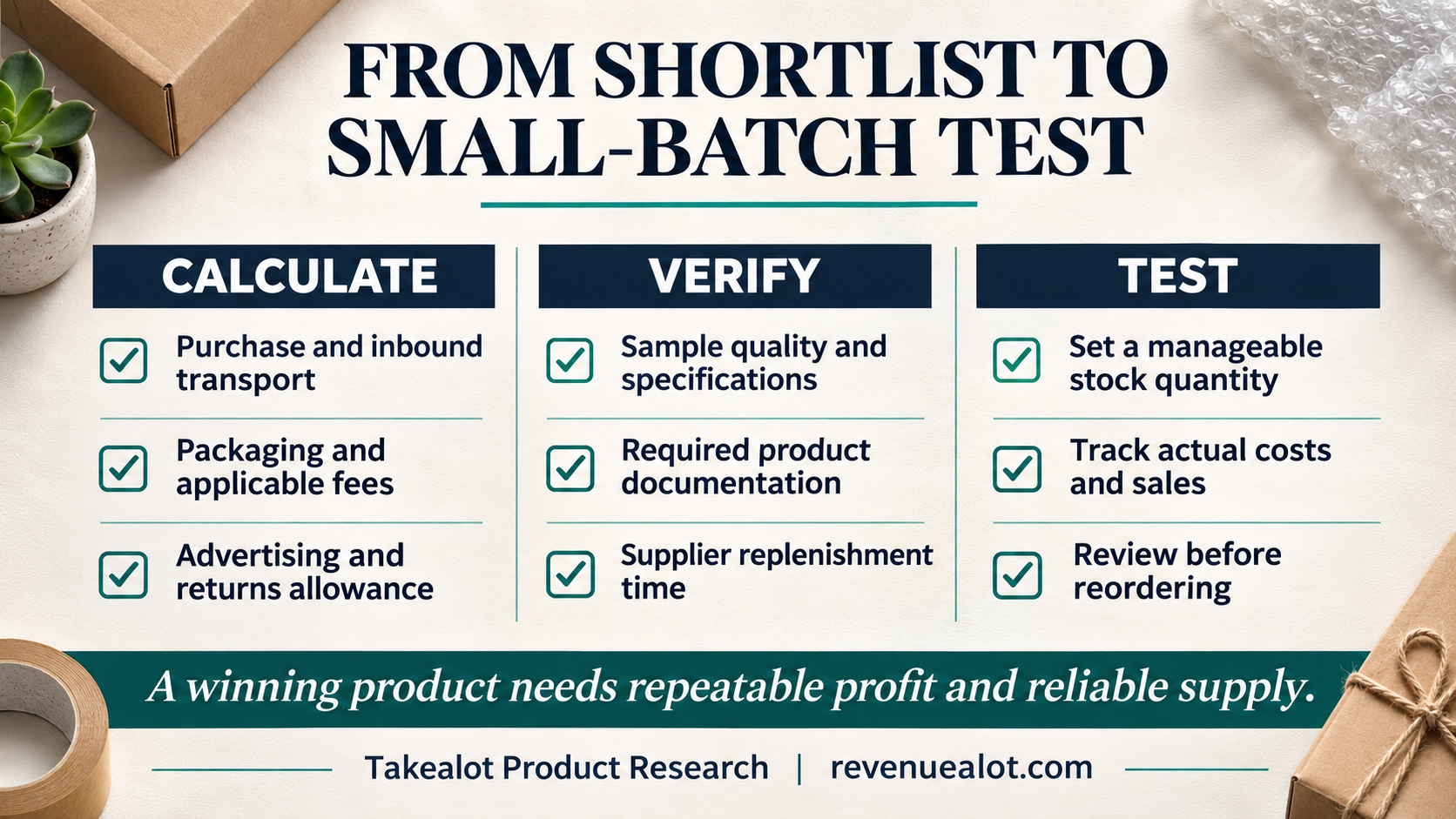
Obtain a written supplier quote for the exact specification and quantity. Include transport to your receiving location and, where relevant, import-related costs.
Then check the applicable Takealot fees for your product and fulfilment arrangement using current seller information. Do not apply one assumed fee percentage across every candidate.
The following example is illustrative, not a Takealot fee quotation. Figures use a consistent VAT-exclusive basis.
Item | Amount per unit |
|---|---|
Selling revenue | R300 |
Product purchase cost | R110 |
Allocated inbound transport | R15 |
Packaging and preparation | R5 |
Assumed marketplace and fulfilment charges | R65 |
Advertising allowance | R15 |
Returns and damage allowance | R10 |
Contribution after listed costs | R80 |
The contribution margin is R80 ÷ R300, or approximately 26.7%. This still needs to cover overheads and other business expenses.
If selling revenue falls to R270, contribution falls to R50 when the listed costs stay unchanged. Recalculate any charges that vary with price. This stress test shows how much room you have before a product becomes unattractive.
Check the Product Before Buying Inventory
Order a sample and compare it with the intended listing specification. Test the features customers mention in reviews.
Before approving stock, confirm:
The supplied model, dimensions, materials and pack quantity.
Packaging strength and any preparation needed.
Applicable category requirements, documentation and brand permissions.
How defects, replacements and warranty queries will be handled.
Keep the sample approval and supplier specification together so that later deliveries can be checked against them.
Set a Test Budget and Reorder Rule
Choose a first order based on the cash you can afford to commit and the supplier’s minimum quantity. Include preparation and selling costs in the budget.
For example, if your test budget is R6,000 and each prepared unit costs R150 before sale-related charges, buying 40 units would consume the entire budget. A smaller order leaves room for advertising, returns and delays.
During the test, record units sold, realised selling prices, actual charges, advertising spend, returns and remaining stock. Revenuealot’s Product Analytics provides individual product performance and sales-trend analysis that can support this review; reconcile the results with your own cost records.
Reorder when observed demand and contribution justify it. Investigate weak results before discounting: the issue could involve price, product information, delivery expectations or the product itself.
4. Turn Takealot Product Research Into a Buying Decision
A buying decision should explain why a particular product deserves your money.
Before ordering, confirm that you have comparable listings, credible demand signals, an approved sample, a complete cost calculation and a manageable test quantity. Record the conditions that would make you stop buying.
Keep research estimates separate from actual trading results. For example, Revenuealot describes Black Box sales and revenue estimates based on review-to-sales conversion; those figures should not be presented as verified competitor transactions.
The strongest candidate is a product you can source consistently, sell at a sustainable contribution and replenish without placing unnecessary pressure on cash flow.
5. FAQs About Takealot Product Research
How Can I Estimate Demand on Takealot?
Combine recent review activity, relevant search interest, comparable listings and available research estimates. Validate the opportunity through a controlled stock test.
Should I Choose a Popular Category or a Small Niche?
Compare sourcing reliability, competition and contribution. A niche with limited demand can be just as difficult as a crowded category.
What Profit Margin Should I Target?
Set a minimum contribution that covers your overheads and leaves room for price changes, advertising and returns. Test the calculation at a lower selling price.
How Much Stock Should I Buy Initially?
Use your available cash, supplier minimum order and replenishment time to set the quantity. Preserve funds for costs that arise after purchasing stock.
Can I Sell a Product Other Sellers Already Offer?
Investigate whether you can provide a competitive, profitable offer and meet the applicable product and selling requirements. Existing competition alone does not answer those questions.